Tuesday, August 18, 2009


Friday, August 14, 2009
ARGENTINA: In Zanon, the capitalists have been expropriated!
[From http://www.ft-ci.org] [Cde Alejandro did most of the work on this translation. -- YM]
Videos: http://www.pts. org.ar/spip. php?article13388
"Eight years have already passed: we do not want any more sweet talk we want expropriation!" roared the Zanon ceramics workers, accompanied by a big column of state workers, teachers, health workers, social organizations and leftist parties, on the way to the Neuquén legislature, where they would deal with the expropriation of the factory.
The Patagonian wind blew cold and strong, making the wait in front of the provincial Congress unbearable. The ceramics workers, who, eight years ago, dared and seized the plant, started it producing and made their epic a part of the best pages of working-class history of our country, were proudly singing, "Here they are, these are them, the workers of Zanon!" until their throats grew hoarse.
In the days before, Neuquén was a hotbed. Although the Governor had decided in favor of expropriation, complaints were heard from his own party, the MPN, from the right-wing opposition, and from the [union federation] CGT itself, because the factory was being handed over to "lefties," to "criminals." They did not spare any insult, in order to discredit the exemplary struggle of the ceramics workers. The CGT union bureaucracy and the Chamber of Commerce came out to prevent the expropriation from being approved. But they couldn't.
In the days before, Neuquén was a hotbed. Although the Governor had decided in favor of expropriation, complaints were heard from his own party, the MPN, from the right-wing opposition, and from the [union federation] CGT itself, because the factory was being handed over to "lefties," to "criminals." They did not spare any insult, in order to discredit the exemplary struggle of the ceramics workers. The CGT union bureaucracy and the Chamber of Commerce came out to prevent the expropriation from being approved. But they couldn't.
Videos: http://www.pts. org.ar/spip. php?article13388
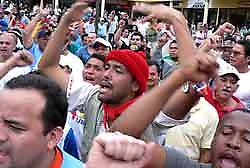
The anti-coup resistance in HONDURAS has reached the 48th consecutive day
Wednesday, August 12, 2009
New imperialist bases in COLOMBIA
From http://www.ft-ci.org
By Claudia Cinatti
Thursday, August 6, 2009
By Claudia Cinatti
Thursday, August 6, 2009
Álvaro Uribe has just signed a new agreement with Barack Obama for the installation of US soldiers in another seven bases on Colombian territory, that would substitute for the base at Manta, Ecuador, that the United States is vacating because of Rafael Correa's decision not to renew the lease which expired after ten years. In this way, Obama has asserted the military and political alliance with Uribe, one of Bush's main allies in the region.
This policy of Uribe has caused tensions with other governments of the region. Venezuelan President Hugo Chávez denounced it as a direct threat, and Brazil complained because it does not agree with the increase in the US military presence in the vicinity of the Amazon. Several Latin American governments, like that of Cristina Fernández de Kirchner, are welcoming President Uribe, who organized a regional tour to reduce opposition to his military policy in view of the next meeting of UNASUR, which will be held in Quito on August 10.
On August 5, a demonstration was held in Buenos Aires, repudiating Uribe's visit and the installation of new US military facilities, which constitute a concrete threat to all the peoples of the region. It is necessary to strengthen the mobilization throughout Latin America to expel imperialism from our continent.
With the excuse of the "fight against drug trafficking" under Clinton and with Bush's "war against terror," Colombia has become the main military concentration of the United States in Latin America, with thousands of agents, advisers, and intelligence services that have been devoted to training paramilitary militias and death squads, responsible for the assassinations of union leaders, campesinos and members of the FARC. The military incursion into Ecuadorean territory against a FARC camp in March 2008, in which Raúl Reyes was killed, was organized from these bases.
On August 5, a demonstration was held in Buenos Aires, repudiating Uribe's visit and the installation of new US military facilities, which constitute a concrete threat to all the peoples of the region. It is necessary to strengthen the mobilization throughout Latin America to expel imperialism from our continent.
Thursday, August 6, 2009
In VENEZUELA, the draft law on "media crimes" is no longer current
LE MONDE.FR 06 AUG 09 13:55 hours • Updated 06 AUG 09 13:55 hours
By Marie Delcas, Bogota Correspondant
The media remain at the heart of Venezuelan political debate. Presented on Monday, August 3, a bill on "media crimes" was buried on Wednesday. "Examining it is not a topic," Ivan Zerpa, secretary general of the Assembly, specified. Several deputies from Chávez' majority had expressed their disagreement with the text, presented by the Republic's top prosecutor, Sra. Luisa Ortega.
But, during a press conference, President Hugo Chávez defended the need for the state to regulate press freedom. "While laws and a constitution exist, no freedom is without limits," the Chief of State recalled, on Wednesday. "If you want to live where there is no law, then go live with Tarzan in the jungle."
Frequencies not renewed
The bill proposed punishments of up to 4 years in prison for the authors of "false" or "manipulated" news undermining "social peace, national security, or public morality." The text caused an outcry among NGO's like Human Rights Watch, Amnesty International and Reporters without Borders. Anxiety of the media and of those who defend freedom of the press is accordingly more intense because, since Sunday, 32 radio stations and 2 local television stations have stopped broadcasting, the national television commission (Conatel) having decided not to renew their frequency. If the commission is to be believed, the punished operators had failed to observe technical and administrative standards. Some two hundred other radio and television stations could experience an identical fate.
The topic contributes to increasing the divisions in the country. President Hugo Chávez considers that privately-owned media -- that remain virulently opposed to him -- are in the hands of an reactionary, even pro-coup, oligarchy. For the opposition, on the other hand, the government is trying to muzzle the press and put an end to freedom of expression.
The tension makes itself felt in the street. On Tuesday, in the east of the country, a demonstration in support of one of the silenced radio stations turned into a confrontation between "chavistas" and "anti-chavistas." Ten people were injured. The day before, thirty supporters of President Hugo Chávez -- some of them armed -- had surrounded the headquarters of the Globovisión television channel, very critical of the government. Security cameras filmed the scene, the tear-gas grenades thrown by demonstrators and the presence among them of Lina Ron, leader of hard-line "chavismo."
The public prosecutor immediately ordered the arrest of the political leader. Hugo Chávez approved the measure and publicly condemned the attack against Globovisión headquarters. "Acts of this nature cannot be tolerated, whether they come from the opposition or not, from revolutionaries or from pseudo-revolutionaries or from whoever it might be," the Chief of State declared. On Wednesday, Lina Ron surrendered to the authorities.
Globovisión is the object of five administrative processes and one judicial investigation for "incitement to violence."
By Marie Delcas, Bogota Correspondant
The media remain at the heart of Venezuelan political debate. Presented on Monday, August 3, a bill on "media crimes" was buried on Wednesday. "Examining it is not a topic," Ivan Zerpa, secretary general of the Assembly, specified. Several deputies from Chávez' majority had expressed their disagreement with the text, presented by the Republic's top prosecutor, Sra. Luisa Ortega.
But, during a press conference, President Hugo Chávez defended the need for the state to regulate press freedom. "While laws and a constitution exist, no freedom is without limits," the Chief of State recalled, on Wednesday. "If you want to live where there is no law, then go live with Tarzan in the jungle."
Frequencies not renewed
The bill proposed punishments of up to 4 years in prison for the authors of "false" or "manipulated" news undermining "social peace, national security, or public morality." The text caused an outcry among NGO's like Human Rights Watch, Amnesty International and Reporters without Borders. Anxiety of the media and of those who defend freedom of the press is accordingly more intense because, since Sunday, 32 radio stations and 2 local television stations have stopped broadcasting, the national television commission (Conatel) having decided not to renew their frequency. If the commission is to be believed, the punished operators had failed to observe technical and administrative standards. Some two hundred other radio and television stations could experience an identical fate.
The topic contributes to increasing the divisions in the country. President Hugo Chávez considers that privately-owned media -- that remain virulently opposed to him -- are in the hands of an reactionary, even pro-coup, oligarchy. For the opposition, on the other hand, the government is trying to muzzle the press and put an end to freedom of expression.
The tension makes itself felt in the street. On Tuesday, in the east of the country, a demonstration in support of one of the silenced radio stations turned into a confrontation between "chavistas" and "anti-chavistas." Ten people were injured. The day before, thirty supporters of President Hugo Chávez -- some of them armed -- had surrounded the headquarters of the Globovisión television channel, very critical of the government. Security cameras filmed the scene, the tear-gas grenades thrown by demonstrators and the presence among them of Lina Ron, leader of hard-line "chavismo."
The public prosecutor immediately ordered the arrest of the political leader. Hugo Chávez approved the measure and publicly condemned the attack against Globovisión headquarters. "Acts of this nature cannot be tolerated, whether they come from the opposition or not, from revolutionaries or from pseudo-revolutionaries or from whoever it might be," the Chief of State declared. On Wednesday, Lina Ron surrendered to the authorities.
Globovisión is the object of five administrative processes and one judicial investigation for "incitement to violence."
Tuesday, August 4, 2009
Chavistas physically attack TV station in VENEZUELA
[Incredibly, it is not enough for Chávez and chavistas that the pro-censorship Venezuelan government has just shut down dozens of media outlets and threatens to silence 200 more. Chávez' followers have now launched a (first) terrorist attack on a dissident TV station, and even that is not sufficient. As reported below, the National Assembly is now discussing a law that would put journalists in jail for publishing criticism of great leader Chávez. What Chávez worshippers refuse to understand is that such repressive legislation can always easily be used against workers' organizations and the left. That's why it must be opposed. -- YM]
[From http://news.bbc.co.uk/2/hi/americas/8184671.stm]
Page last updated at 23:40 GMT, Tuesday, 4 August 2009 00:40 UK
Chavez backer held over TV attack
A pro-government activist in Venezuela has handed herself over to the authorities a day after a violent attack on an opposition TV station.
President Hugo Chavez said left-wing militant Lina Ron, who has been one of his most ardent supporters, would now face the full weight of the law.
He deplored the attack on Globovision TV, and said it would help his opponents brand him as a tyrant.
More than 30 people stormed the station in Caracas, firing tear gas.
"She [Lina Ron] handed herself in, and it's good that she presented herself, and has been arrested. There was no other alternative," Mr Chavez said.
He described the attack as a "counter-revolutionary" act, saying that it "gives the enemy weapons to attack me even more as a tyrant".
The attackers have been identified by officials as activists from from the Union Patriotica Venezolana (UPV), which supports Mr Chavez.
Globovision, which has been highly critical of President Chavez, is facing several investigations that could also take it off air.
New media bill
Monday's attack came as the arguments over control of the media in Venezuela became increasingly bitter.
Thirty-four radio stations were ordered off air after the government said they were in breach of the rules for registering or had allowed their broadcast licences to expire. Some 200 other stations are under investigation.
The government in Caracas says it is trying to make the media more democratic.
"The state is retaking control of concessions that were being used in an illegal way over more than 30 and 40 years," said Public Works Minister Diosdado Cabello, who is the head of the telecommunications agency.
"It's an act of justice."
But critics say the move is aimed at giving more space to media that support Mr Chavez and is an attempt to muzzle any critical voices.
Venezuela's National Assembly is due on Tuesday to begin discussing legislation under which journalists could be imprisoned for up to four years for broadcasting or publishing material that attacks "the peace, security, and independence of the nation and the institutions of the state".
Venezuela still has many private radio stations and newspapers that are stridently opposed to the president but in recent years the government has built up its network of state-run media.
[From http://news.bbc.co.uk/2/hi/americas/8184671.stm]
Page last updated at 23:40 GMT, Tuesday, 4 August 2009 00:40 UK
Chavez backer held over TV attack
A pro-government activist in Venezuela has handed herself over to the authorities a day after a violent attack on an opposition TV station.
President Hugo Chavez said left-wing militant Lina Ron, who has been one of his most ardent supporters, would now face the full weight of the law.
He deplored the attack on Globovision TV, and said it would help his opponents brand him as a tyrant.
More than 30 people stormed the station in Caracas, firing tear gas.
"She [Lina Ron] handed herself in, and it's good that she presented herself, and has been arrested. There was no other alternative," Mr Chavez said.
He described the attack as a "counter-revolutionary" act, saying that it "gives the enemy weapons to attack me even more as a tyrant".
The attackers have been identified by officials as activists from from the Union Patriotica Venezolana (UPV), which supports Mr Chavez.
Globovision, which has been highly critical of President Chavez, is facing several investigations that could also take it off air.
New media bill
Monday's attack came as the arguments over control of the media in Venezuela became increasingly bitter.
Thirty-four radio stations were ordered off air after the government said they were in breach of the rules for registering or had allowed their broadcast licences to expire. Some 200 other stations are under investigation.
The government in Caracas says it is trying to make the media more democratic.
"The state is retaking control of concessions that were being used in an illegal way over more than 30 and 40 years," said Public Works Minister Diosdado Cabello, who is the head of the telecommunications agency.
"It's an act of justice."
But critics say the move is aimed at giving more space to media that support Mr Chavez and is an attempt to muzzle any critical voices.
Venezuela's National Assembly is due on Tuesday to begin discussing legislation under which journalists could be imprisoned for up to four years for broadcasting or publishing material that attacks "the peace, security, and independence of the nation and the institutions of the state".
Venezuela still has many private radio stations and newspapers that are stridently opposed to the president but in recent years the government has built up its network of state-run media.
VENEZUELA: The government occupies coffee factories
[Webster defines a quintal, a measure used in the following story, as 100 kilograms, i.e., 220.46 pounds. The nationalizations mentioned in the second paragraph were actually purchases by the Chávez government, at very generous prices, of energy and telecommunications firms. As the story indicates, the occupations of the coffee production factories will be temporary. Chávez has great respect for the sanctity of private ownership of the means of production; one can see that from the fact that after ten years of Chávez in power, Venezuelan workers are still exploited by capitalists. So if the coffee industry is nationalized, the owners will undoubtedly get very, very large compensation for their factories, which proves, once again, that chavismo is simply a lot of flatulent rhetoric, nothing more. Where workers have, in fact, recovered owner-abandoned enterprises and restarted those factories under workers' self-management, as in the case of Sanitarios Maracay, the Chávez government refused to nationalize those enterprises. Just last month, workers from the Vivex enterprise, occupied by its workers for 7 months, marched all the way from Barcelona, Venezuela, to Caracas, 300 kilometers in 12 days, hoping to be allowed to talk to Chávez and persuade him to nationalize their enterprise; those workers were apparently never received by the Venezuelan President. For details, see http://venezuela.elmilitante.org/content/view/6533/164/-- YM]
Venezuela : The government occupies coffee production factories
LEMONDE.FR with AFP 03.08.09 17:24 hours
On the morning of Monday, August 3, Venezuela's socialist [sic] govenment ordered the temporary occupation of the factories of two local coffee producers, accused especially of fraudulent and "monopolistic" practices at the root of the shortage of this product in the country.
"The Bolivarian government has occupied all the factories in the country of the company Fama de América and of Café Madrid, to guarantee supplies for the Venezuelan people," the Minister of Agriculture, Elías Jaua, explained to state-run television. These occupations come within the scope of the law on food sovereignty, promulgated at the end of last year by the antiliberal President Hugo Chávez, who is strengthening control over production by food companies, in order to fight against shortages. As part of his socialist revolution [sic], the Venezuelan President has already nationalized several key sectors of the economy, like energy or telecommunications.
Disloyal and monopolistic practices
According to an association, Alianza Agroalimentaria, coffee production went from 1,400,000 quintals in 1998 to 900,000 today. The Minister indicated that the occupation of the factories should last three months, the time to carry out a complete audit of the two enterprises. "If we could show that smuggling, retentions, disloyal and monopolistic practices had taken place, we could consider nationalization of these enterprises," he specified.
In recent months, the Venezuelan government has ordered the occupation and expropriation of several enterprises producing staples, like rice or pasta, in an attempt to put an end to chronic shortages. Since 2003, the biggest Latin American oil exporter has put in place a strict regime of price control for staple foods. Food producers regularly denounce this measure, asserting that prices do not even cover their production costs.
Venezuela : The government occupies coffee production factories
LEMONDE.FR with AFP 03.08.09 17:24 hours
On the morning of Monday, August 3, Venezuela's socialist [sic] govenment ordered the temporary occupation of the factories of two local coffee producers, accused especially of fraudulent and "monopolistic" practices at the root of the shortage of this product in the country.
"The Bolivarian government has occupied all the factories in the country of the company Fama de América and of Café Madrid, to guarantee supplies for the Venezuelan people," the Minister of Agriculture, Elías Jaua, explained to state-run television. These occupations come within the scope of the law on food sovereignty, promulgated at the end of last year by the antiliberal President Hugo Chávez, who is strengthening control over production by food companies, in order to fight against shortages. As part of his socialist revolution [sic], the Venezuelan President has already nationalized several key sectors of the economy, like energy or telecommunications.
Disloyal and monopolistic practices
According to an association, Alianza Agroalimentaria, coffee production went from 1,400,000 quintals in 1998 to 900,000 today. The Minister indicated that the occupation of the factories should last three months, the time to carry out a complete audit of the two enterprises. "If we could show that smuggling, retentions, disloyal and monopolistic practices had taken place, we could consider nationalization of these enterprises," he specified.
In recent months, the Venezuelan government has ordered the occupation and expropriation of several enterprises producing staples, like rice or pasta, in an attempt to put an end to chronic shortages. Since 2003, the biggest Latin American oil exporter has put in place a strict regime of price control for staple foods. Food producers regularly denounce this measure, asserting that prices do not even cover their production costs.
Sunday, August 2, 2009
Chávez attacks press freedom in VENEZUELA
[For the record, the young Marx began his career as a journalist with several articles blasting censorship by the state. For details, see the first volume of Hal Draper's magnum opus, Karl Marx' Theory of Revolution. So it's fair to say there is a precedent for Marxist opposition to censorship by a bourgeois government, like the Chávez administration, which has 10 years in power devoted to preserving the bourgeois state machine, with the highest inflation rate in Latin America (according to some sources, a really punishing 40%) and zero power for the working class. -- YM]
Venezuela shuts down 34 radio stations and television channels
LEMONDE.FR with AP and AFP Aug 1 09 21:12 hours • Updated Aug 1 09 21:40 hours
Venezuelan President Hugo Chávez' government has cancelled the licenses of 34 radio stations and television channels, officially because of administrative reasons, while warning 200 other stations that their broadcasts were also threatened, restarting the controversy over recent attacks ["atteints"] on freedom of expression in the country.
The targeted ["visées"] radio and television stations suspended their broadcasts on Saturday, August 1, and some hundreds of people immeidately gathered at their headquartes in protest. "No to censorship," "People, open your eyes, it's a dictatorship," proclaimed the placards in front of the Caracas headquarters of the CNB group of radio stations, one of the suspended media that was critical of the Venezuelan President.
Organizations defending human rights are accusing President Chávez of tightening his control over the media in order to stifle any dissident voice. "We are witnessing the biggest operation of restricting freedom of expression ever set up in Venezuela, without precedent in the democratic period," declared Carlos Correa, Director of the NGO defending freedom of expression, Espacio Público.
"Media crimes"
These "administrative" closings are taking place just as the government is preparing a series of reforms aiming, according to the government, at "democratizing" a still very concentrated sector. This new law punishing "media crimes," to which the Spanish daily El País is devoting a dossier, should be adopted before the end of the year. This new legislation would punish the owners of radio stations, television networks and newspapers accused of having tried to "sow panic," or, again, having "disturbed the social order." Media that "falsify information with a view to spreading a wrong perception of the facts," are also in the [government's] line of sight.
Private-sector media feel that these reforms would result in strengthening the state's influence on information, a concern that Venezuela's top prosecutor, Sra. Luisa Ortega, who on Thursday insisted that freedom of expression in Venezuela must be "limited," is not seeking to dispel....
Venezuela shuts down 34 radio stations and television channels
LEMONDE.FR with AP and AFP Aug 1 09 21:12 hours • Updated Aug 1 09 21:40 hours
Venezuelan President Hugo Chávez' government has cancelled the licenses of 34 radio stations and television channels, officially because of administrative reasons, while warning 200 other stations that their broadcasts were also threatened, restarting the controversy over recent attacks ["atteints"] on freedom of expression in the country.
The targeted ["visées"] radio and television stations suspended their broadcasts on Saturday, August 1, and some hundreds of people immeidately gathered at their headquartes in protest. "No to censorship," "People, open your eyes, it's a dictatorship," proclaimed the placards in front of the Caracas headquarters of the CNB group of radio stations, one of the suspended media that was critical of the Venezuelan President.
Organizations defending human rights are accusing President Chávez of tightening his control over the media in order to stifle any dissident voice. "We are witnessing the biggest operation of restricting freedom of expression ever set up in Venezuela, without precedent in the democratic period," declared Carlos Correa, Director of the NGO defending freedom of expression, Espacio Público.
"Media crimes"
These "administrative" closings are taking place just as the government is preparing a series of reforms aiming, according to the government, at "democratizing" a still very concentrated sector. This new law punishing "media crimes," to which the Spanish daily El País is devoting a dossier, should be adopted before the end of the year. This new legislation would punish the owners of radio stations, television networks and newspapers accused of having tried to "sow panic," or, again, having "disturbed the social order." Media that "falsify information with a view to spreading a wrong perception of the facts," are also in the [government's] line of sight.
Private-sector media feel that these reforms would result in strengthening the state's influence on information, a concern that Venezuela's top prosecutor, Sra. Luisa Ortega, who on Thursday insisted that freedom of expression in Venezuela must be "limited," is not seeking to dispel....
Tuesday, July 21, 2009
Clashes erupt at South Korea car plant
[Courtesy of cde John L -- May his tribe increase!]
South Korean riot police backed up by armour and helicopters, have clashed with hundreds of sacked auto workers who have been holed up in a car factory outside of Seoul for almost two months. Several of the protesters used high-powered slingshots to fire nuts and bolts at police from factory rooftops as they tried to storm the Ssangyong motors car plant on Tuesday. Some 3,000 riot police have been deployed to the plant at Pyeongtaek, about 70km south of Seoul, in an effort to clear up to 600 sacked workers who have occupied the factory's paint shop.
Ssangyong is South Korea's fifth-largest automaker and the occupation which began in late May has paralysed production at the plant. Police first entered the factory on Monday after the company cut off water and gas supplies to the plant in an effort to force the workers to leave. As they did so, protesters tried to block their path by setting light to vehicles and tyres while pelting police with shrapnel from catapults.
Job cuts
The workers began their occupation on May 21 in protest at job cuts designed as part of a restructuring plan to save the troubled carmaker. Ssangyong, which is majority-owned by Shanghai Automotive Industry Corp., has been in court-approved bankruptcy protection since February. South Korean media reports have said the paint shop, where most of the protesters are holed-up, contains flammable materials that could potentially ignite amid a major clash.
As part of its restructuring plan, Ssangyong aims to shed 36 per cent of its workforce or about 2,646 jobs. According to the company, some 1,670 have left the company voluntarily, but nearly 1,000 opposed the move and some were later fired. Ssangyong mostly manufactures light SUVs and a luxury sedan – sales of which have plummeted in the global economic downturn.
The company sold 13,020 vehicles during the first six months of the year, down 73.9 percent from the same period in 2008, according to South Korea's Yonhap news agency. Government officials have warned that unless the occupation of the factory ends and production resumes, any hope of saving the company will evaporate.
Wednesday, July 15, 2009
Is Obama Continuing the Bush-Cheney Assassination Program?
[Courtesy of antiwar.com http://original.antiwar.com/scahill/2009/07/14/is-obama-continuing/]
Is Obama Continuing the Bush-Cheney Assassination Program?
by Jeremy Scahill, July 15, 2009
Is Obama Continuing the Bush-Cheney Assassination Program?
by Jeremy Scahill, July 15, 2009
In June, CIA Director Leon Panetta allegedly informed members of the House Intelligence Committee of the existence of a secret Bush-era program implemented in the days after 9/11 that, until last month, had been hidden from lawmakers. The concealment of the plan, Panetta alleged, happened at the orders of then-vice president Dick Cheney.
Now, the New York Times is reporting that this secret program that had "been hidden from lawmakers" by Cheney was a plan "to dispatch small teams overseas to kill senior Qaeda terrorists." The Wall Street Journal, which originally reported on the plan, reported that the paramilitary teams were to implement a"2001 presidential legal pronouncement, known as a finding, which authorized the CIA to pursue such efforts.
"The plan, the Times says, never was carried out because "Officials at the spy agency over the years ran into myriad logistical, legal, and diplomatic obstacles." Instead, the Bush administration "sought an alternative to killing terror suspects with missiles fired from drone aircraft or seizing them overseas and imprisoning them in secret CIA jails."
The House Intelligence Committee is now reportedly preparing an investigation into this program and the Senate may follow suit. "We were kept in the dark.That's something that should never, ever happen again," said Senate Intelligence Committee Chairman Dianne Feinstein. Withholding this information from Congress "is a big problem, because the law is very clear."
There are several important issues raised by this unfolding story. First, while the Times claims the program was never implemented, the program sounds very similar to what Pulitzer Prize-winning journalist Sy Hersh described in March as an "executive assassination ring" run by Dick Cheney that operated throughout the Bush years:
"Congress has no oversight of it. It's an executive assassination ring essentially, and it's been going on and on and on. Just today in the Times there was a story that its leaders, a three star admiral named [William H.] McRaven, ordered a stop to it because there were so many collateral deaths."
Under President Bush's authority, they've been going into countries, not talking to the ambassador or the CIA station chief, and finding people on a list and executing them and leaving. That's been going on, in the name of all of us."
Hersh's description sounds remarkably similar to that offered by the Times and the Wall Street Journal. While the House and Senate should certainly investigate this program – and lying to Congress, misleading it, or concealing from it suchprograms is likely illegal – it is also important to guarantee that it has actually stopped. But another pressing issue for the Congress is investigating the Obama administration's adoption of this secret program's central components.
As the Times noted, the major reason – beyond logistical hurdles – that the program was not implemented (if that is even true) was that the Bush administration began increasing its use of weaponized drones to conduct Israeli-style targeted assassinations (often, these drones kill many more civilians than so-called "targets"). These drone attacks, coupled with the use of extraordinary rendition and secret prisons, became the official program for "eliminating" specific individuals labeled "high value" targets by the administration.
The Obama administration has not only continued the Bush policy of using drones to carry out targeted assassinations, it has also continued the use of prisons where people are held indefinitely without charge or access to the International Committee of the Red Cross. Under Obama, Bagram air base in Afghanistan is expanding and, at present, hundreds of prisoners are held there without charges. In essence, the Obama administration is doing exactly what this secret CIA program sought to do, albeit out in the open.
Beyond the Cheney assassination program, what is really worthy of congressional investigation right now is the legality of Obama's current policy of assassination. In 1976, President Gerald Ford issued an executive order banning assassinations. "No employee of the United States government shall engage in, or conspire to engage in, political assassination," states Executive Order 11905.
White House lawyers – with their seemingly infinite legal creativity – would likely say that the drone strikes are not assassinations, but rather part of war, that putting poison in a cigar of a foreign leader is different from launching missiles at a funeral where an "enemy" is believed to be among the mourners. While the implications of the U.S. assassinating heads of state or foreign officials are grave, it could be argued that, on some levels, the drone attacks are worse in the sense that they kill many more civilians. Moreover, these drone attacks largely take place in Pakistan, which is a sovereign nation. There is no legal or congressional declaration of war against Pakistan.
It is long past due that the Congress investigate this U.S. government assassination program. The politically inconvenient truth, however, is this: An actual investigation would require the Democrats pounding Cheney over his concealment of an assassination program (that allegedly was not implemented) to focus their investigation on how President Obama actually implemented and expanded that very program.
Saturday, July 11, 2009
Resistance inside the US Military -- Antiwar soldier freed from San Diego brig
Army deserter Robin Long was released this morning from the brig at Miramar Marine Corps Air Station in San Diego after serving 12 months of a 15-month sentence.
Long, 25, of Boise, Idaho, fled to Canada in 2005 to avoid being deployed to Iraq. He said he could not go to Iraq because of his moral opposition to the war that began with the U.S. invasion in 2003.
Long's forced return to the U.S. by Canadian authorities caused a political furor because many Canadians saw it as a reversal of the country's welcoming attitude toward U.S. deserters and draft evaders during the Vietnam War.
"Wow, what a journey the last four years has been," Long said as he left the brig. He was accompanied by Dawn O'Brien, a board member of Veterans for Peace and a leader in Military Families Speak Out.
After being returned to this country, an Army court-martial sentenced Long to 15 months and a dishonorable discharge.
Even after he is processed out of the Army, Long may not be able to return to Canada, where his girlfriend and their 2-year-old son reside. Canadian law prohibits convicted felons from entering the country, although Long's supporters have vowed to appeal.
Long enlisted in 2003 and was stationed at Ft. Carson, Colo., as a private when his unit was ordered to Iraq. In Canada, his application for refugee status was rejected. His supporters said he was the first U.S. service member to be deported from Canada during the Iraq war.
In Canada, Long opened a business encouraging water conservation.
-- Tony Perry in San Diego
Monday, July 6, 2009
No negotiation with the murderous coup participants in Honduras!
“NO NEGOTIATION WITH THE MURDEROUS COUP PARTICIPANTS IN HONDURAS" PRESS RELEASE
(PTS, July 6, 2009) Christian Castillo, national leader of the Partido de los Trabajadores Socialistas (PTS), indicated today that, "in view of the murder of two demonstrators and tens of people wounded this Sunday, during the massive demonstration in the Toncontin Airport, it is necessary to intensify the actions against the coup in Honduras. Words and communiqués of repudiation are not enough. Thousands of us have to be in the streets, repudiating the murderous coup participants and backing the workers, campesinos and students who are confronting them in the streets." Castillo also stated that "we charge that beyond the declarations of rejection in the OAS and the UN, there is a continuing attempt to make the coup acceptable and arrive at an understanding with the coup participants. In order to defeat that, it is necessary to increase the workers' and people's mobilization, both in Honduras and throughout Latin America. For that reason, we say: Down with the coup by the Honduran bourgeoisie, the Armed Forces, the Supreme Court of Justice, the Parliament, the churches and the big communications media! The blood of our Honduran brothers, that was spilled, is not to be negotiated!"
Saturday, July 4, 2009
Down with the coup and the state of siege in HONDURAS!
Friday, July 3, 2009
Press release
Down with the coup and the state of siege in Honduras!
No negotiations with the coup plotters!
All our solidarity with the women and all the Honduran people in struggle
Down with the coup and the state of siege!
No negotiations with the coup plotters!
US imperialism, get out!
Our solidarity is with the women and all the Honduran people in struggle!
Press release
Down with the coup and the state of siege in Honduras!
No negotiations with the coup plotters!
All our solidarity with the women and all the Honduran people in struggle
(Buenos Aires, July 3, 2009) The group Pan y Rosas – as it has done from the beginning – expresses its most vigorous repudiation of the coup d'état in Honduras perpetrated by groups of the Honduran bourgeoisie, with the active collaboration of the Armed Forces, the Supreme Court of Justice, the Parliament, the churches and the big communications media. We also reject the state of siege decreed on July 1 by Micheletti's de facto government, that is reducing the democratic freedoms of the Honduran people even more, and we demand the immediate release of the arrested militants.
In addition, we reject the interference of the OAS – commanded by US imperialism – whose Secretary General, José Miguel Insulza, will arrive in Honduras today with the obvious intention of negotiating "a solution to the political crisis" with the coup plotters. This "solution" is nothing other than the reestablishment of a regime that, with or without Zelaya, not only guarantees the interests of Honduran businessmen and landowners, but also future impunity for the coup participants.
In addition, we reject the interference of the OAS – commanded by US imperialism – whose Secretary General, José Miguel Insulza, will arrive in Honduras today with the obvious intention of negotiating "a solution to the political crisis" with the coup plotters. This "solution" is nothing other than the reestablishment of a regime that, with or without Zelaya, not only guarantees the interests of Honduran businessmen and landowners, but also future impunity for the coup participants.
Women in struggle, the working people of Honduras, and those of us who are mobilizing throughout Latin America and the world against the coup, cannot trust that the OAS – that, in its history, recognized all the bloodthirsty dictatorships of Latin America in the 1970's and 1980's, that backed the criminal blockade of Cuba for more than four decades, and that supports the submission of Latin American countries to imperialism – can give a solution that would favor the popular sectors and their democratic freedoms. Quite the contrary: it seeks an "agreed upon" solution with the coup plotters. For that reason, we the women of Pan y Rosas call for the broadest popular mobilization against the coup in Honduras and for trusting only in our own strength, that of the exploited and oppressed, to overthrow the coup and prevent the consolidation of a reactionary conclave in the region, setting a terrible precedent on our continent.
Down with the coup and the state of siege!
No negotiations with the coup plotters!
US imperialism, get out!
Our solidarity is with the women and all the Honduran people in struggle!
Thursday, July 2, 2009
Down with the coup in HONDURAS!
Down with the coup in HONDURAS!
From <http://www.ft-ci.org/>
Declaration of the FT-CI
Down with the coup in Honduras!
By Fracción Trotskista - Cuarta Internacional
Down with the coup in Honduras!
For the broadest mobilization throughout Latin America to defeat the coup plotters
From <http://www.ft-ci.org/>
Declaration of the FT-CI
Down with the coup in Honduras!
By Fracción Trotskista - Cuarta Internacional
Down with the coup in Honduras!
For the broadest mobilization throughout Latin America to defeat the coup plotters
The morning of June 28 witnessed a new military coup in Central America, this time in Honduras, where the ultra-rightists, backed up by the armed forces, but in coordination with the Electoral Court, the Courts of Justice and the Parliament, removed the constitutional President Manuel Zelaya, from office, by force. After a little more than 200 soldiers surrounded Zelaya's personal residence, a confrontation took place between army squadrons and the President's personal guard, and he was kidnapped and expelled from the country.
Friday, June 26, 2009
IRAN: The regime imposes fraud through repression
IRAN: The regime imposes fraud through repression
By Claudia Cinatti
From http://www.ft-ci.org
La Verdad Obrera Nº 331 / International
Thursday, June 25, 2009
After ten days of massive mobilizations, the repressive apparatus of the Iranian regime seems to have restored order, temporarily, in the streets of Tehran.
In his sermon on June 19, the Supreme Leader of the Islamic Republic, the Ayatollah Ali Khamenei, reaffirmed his alignment with Ahmadinejad and announced that he had decided to put an end to the movement under way, saying that he was not going to tolerate the protests any more and threatening a "bloodbath."
Read more at: http://my.opera.com/trotskist/blog/iran-repression
By Claudia Cinatti
From http://www.ft-ci.org
La Verdad Obrera Nº 331 / International
Thursday, June 25, 2009
After ten days of massive mobilizations, the repressive apparatus of the Iranian regime seems to have restored order, temporarily, in the streets of Tehran.
In his sermon on June 19, the Supreme Leader of the Islamic Republic, the Ayatollah Ali Khamenei, reaffirmed his alignment with Ahmadinejad and announced that he had decided to put an end to the movement under way, saying that he was not going to tolerate the protests any more and threatening a "bloodbath."
Read more at: http://my.opera.com/trotskist/blog/iran-repression
Tuesday, June 23, 2009
Message of the Free Trade Union of Iranian Workers to Iranian workers
[From the web, it is impossible to know how many workers are represented by the Free Trade Union of Iranian Workers, but this union has an honorable record of participating in coalitions inside Iran that demand rights for workers. The text that follows is courtesy of the Iranian Workers Solidarity Network (IWSN), a very worthwhile organization that promotes campaigns worldwide against the repression that the Iranian theocratic government uses to victimize Iranian workers. The webpage of the IWSN is http://www.iwsn.org/ --YM]
Message of the Free Trade Union of Iranian Workers to Iranian workers
Message of the Free Trade Union of Iranian Workers to Iranian workers
Forty-eight days have passed since the suppression and arrests of the workers’ gathering on International Labour Day - May Day. During this time important events have taken place and have caused widespread and amazing changes in the social movement of the country.
During their televised debates the presidential election candidates accused each other of violating the citizens’ rights, embezzlement, theft, mismanagement, and incompetence. But none of them had any objection to the laws that have allowed the disastrous events affecting the majority of the population. None of them had any objection to the law that takes away a worker’s right to strike, sets his wages at a quarter of the poverty line, takes away his right to [form] organisations, allows mass lay-offs, the signing of blank contracts and forces a one-month temporary contract on him.
On the issues of the freedom of speech, the freedom to dress [as you choose], and tens and hundreds of inhuman case that today govern society, they did not say a word, and if they did point to cases in a superficial way, every one of them was an attempt [by the candidate] to clear himself and accuse the other, as if his opponent has been more strict than himself. In all those debates, clearly and in confronting each other, the candidates themselves proved that they accept all the present laws and conditions and that their only quarrel is on snatching power from their opponent.
Therefore, we workers, under the present conditions, when social protests have taken the form of a mass and huge movement that has come on the scene to achieve its demands, it is our right to turn the leaflet with the demands of our fellow working class people, into our banner and to raise it. These demands are as follows:
1- Immediate increase in the minimum wage to over 1 million tomans [$1010] a month.
2- An end to temporary contracts and new forms of work contracts.
3- The disbanding of the Labour House and the Islamic Labour Councils as government organisations in the factories and workshops, and the setting up of shoras [councils] and other workers’ organisations independent from the government.
4- Immediate payment of workers’ unpaid wages without any excuses.
5- An end to laying-off workers and payment of adequate unemployment insurance to all unemployed workers.
6- The immediate release of all political prisoners including the workers arrested on May Day, Jafar Azimzadeh, Gholamreza Khani, Said Yuzi, Said Rostami, Mehdi Farahi-Shandiz, Kaveh Mozafari, Mansour Osanloo and Ebrahim Madadi, and an end to surveillance and harassment of workers and labour leaders.
7- The right to strike, protest, assemble and the freedom of speech and the press are the workers’ absolute right.
8- An end to sexual discrimination, child labour and the sacking of foreign workers.
Workers! Today we have a duty to intervene, to pose our demands independently and by relying on our own united strength, together with other sections of society, to work towards achieving our human rights
The Free Trade Union of Iranian Workers
18 June 2009
Translated by Iranian Workers’ Solidarity Network
Monday, June 22, 2009
IRAN: Vahed bus drivers union condemns repression, supports mass movement against Ahmadinejad
[In the following statement from the web, "Syndicate" means workers' union. The Vahed bus drivers' union is a combative workers' organization. More information about this union can be found at http://www.iwsn.org/campaigns/bus.htm --YM]
Vahed Syndicate – Any Suppression or threat of civil liberty condemned
18 June Statement
Any Suppression or threat of civil liberty condemned
In line with the recognition of the labour rights, we request that June 26 Action Day – Justice for Iranian workers – to include the human rights of all Iranians who have been deprived of their rights.
In recent days, we continue witnessing the magnificent demonstration of millions of people from all ages, genders, and national and religious minorities in Iran. They request that their basic human rights, particularly the right to freedom and to choose independently and without deception be recognized. These rights are not only constitutional in most of the countries, but also have been protected against all odds.
Amid such turmoil, one witnesses threats, arrests, murders and brutal suppression that one fears only to escalate on all its aspects, resulting in more innocent bloodshed, more protests, and certainly no retreats. The Iranian society is facing a deep political-economical crisis. Million-strong silent protests, ironically loud with un-spoken words, have turned into iconic stature and are expanding from all sides. These protests demand reaction from each and every responsible individual and institution.
As previously expressed in a statement published on-line in May of this year, since Syndicate Vahed does not view any of the candidates support the activities of the workers’ organizations in Iran, it would not endorse any presidential candidate in the election. Vahed members nevertheless have the right to participate or not to participate in the elections and vote for their individually selected candidate.
Moreover, the fact remains that demands of almost an absolute majority of the Iranians go far beyond the demands of a particular group. In the past, we have emphasized that until the freedom of choice and right to organize are not recognized, talk of any social or particular right would be more of a mockery than a reality.
The Syndicate of Workers of Tehran and Suburbs Vahed Bus Company fully supports this movement of Iranian people to build a free and independent civil society and condemns any violence and oppression.
In line with the recognition of the labour rights, the Syndicate requests that June 26 which has been called by the International Trade Unions Organization ‘Day of action’ for justice for Iranian workers to include the human rights of all Iranians who have been deprived of their rights.
With hope for freedom and equality
The Syndicate of Workers of Tehran and Suburbs Vahed Bus Company
18 June 2009
Vahed Syndicate – Any Suppression or threat of civil liberty condemned
18 June Statement
Any Suppression or threat of civil liberty condemned
In line with the recognition of the labour rights, we request that June 26 Action Day – Justice for Iranian workers – to include the human rights of all Iranians who have been deprived of their rights.
In recent days, we continue witnessing the magnificent demonstration of millions of people from all ages, genders, and national and religious minorities in Iran. They request that their basic human rights, particularly the right to freedom and to choose independently and without deception be recognized. These rights are not only constitutional in most of the countries, but also have been protected against all odds.
Amid such turmoil, one witnesses threats, arrests, murders and brutal suppression that one fears only to escalate on all its aspects, resulting in more innocent bloodshed, more protests, and certainly no retreats. The Iranian society is facing a deep political-economical crisis. Million-strong silent protests, ironically loud with un-spoken words, have turned into iconic stature and are expanding from all sides. These protests demand reaction from each and every responsible individual and institution.
As previously expressed in a statement published on-line in May of this year, since Syndicate Vahed does not view any of the candidates support the activities of the workers’ organizations in Iran, it would not endorse any presidential candidate in the election. Vahed members nevertheless have the right to participate or not to participate in the elections and vote for their individually selected candidate.
Moreover, the fact remains that demands of almost an absolute majority of the Iranians go far beyond the demands of a particular group. In the past, we have emphasized that until the freedom of choice and right to organize are not recognized, talk of any social or particular right would be more of a mockery than a reality.
The Syndicate of Workers of Tehran and Suburbs Vahed Bus Company fully supports this movement of Iranian people to build a free and independent civil society and condemns any violence and oppression.
In line with the recognition of the labour rights, the Syndicate requests that June 26 which has been called by the International Trade Unions Organization ‘Day of action’ for justice for Iranian workers to include the human rights of all Iranians who have been deprived of their rights.
With hope for freedom and equality
The Syndicate of Workers of Tehran and Suburbs Vahed Bus Company
18 June 2009
Saturday, June 20, 2009
Shout it from the rooftops! Workers in IRAN support the mass movement against Ahmadinejad!!
Reports on the web indicate that on Thursday, June 18, the Vahed Bus Drivers union, representing one of the most combative groups in the workers' movement in Iran, issued a statement in support of the mass movement. This union statement recognizes “the magnificent demonstration of millions of people from all ages, genders, and national and religious minorities in Iran” and states clearly that “the Syndicate of Workers of Tehran and Suburbs Vahed Bus Company fully supports this movement of Iranian people to build a free and independent civil society and condemns any violence and oppression.”
In addition, workers at the gigantic Khodro auto factory, the biggest in the Middle East, having almost 100,000 workers, took action on Thursday, June 18, in support of the mass movement. The striking autoworkers' statement follows:
“We declare our solidarity with the movement of the people of Iran.
“Autoworker, Fellow Laborers (Laborer Friends): What we witness today, is an insult to the intelligence of the people, and disregard for their votes, the trampling of the principles of the Constitution by the government. It is our duty to join this people's movement.
“We the workers of Iran Khodro, Thursday 28/3/88 in each working shift will stop working for half an hour to protest the suppression of students, workers, women, and the Constitution and declare our solidarity with the movement of the people of Iran. The morning and afternoon shifts from 10 to 10:30. The night shift from 3 to 3:30.
“Laborers of Iran Khodro”
Thus, class-consicous workers in Iran have answered all those who claim the heroic mass movement in that country is somehow a result of imperialist manipulation. -- Yosef M
In addition, workers at the gigantic Khodro auto factory, the biggest in the Middle East, having almost 100,000 workers, took action on Thursday, June 18, in support of the mass movement. The striking autoworkers' statement follows:
“We declare our solidarity with the movement of the people of Iran.
“Autoworker, Fellow Laborers (Laborer Friends): What we witness today, is an insult to the intelligence of the people, and disregard for their votes, the trampling of the principles of the Constitution by the government. It is our duty to join this people's movement.
“We the workers of Iran Khodro, Thursday 28/3/88 in each working shift will stop working for half an hour to protest the suppression of students, workers, women, and the Constitution and declare our solidarity with the movement of the people of Iran. The morning and afternoon shifts from 10 to 10:30. The night shift from 3 to 3:30.
“Laborers of Iran Khodro”
Thus, class-consicous workers in Iran have answered all those who claim the heroic mass movement in that country is somehow a result of imperialist manipulation. -- Yosef M
Friday, June 19, 2009
IRAN: Rebellion and political crisis
After the presidential elections--IRAN: rebellion and political crisis
Saturday, 20. June 2009, 01:51:56
La Verdad Obrera 330/International
Thursday, June 18, 2009
By Claudia Cinatti
To read the whole story, go to <http://my.opera.com/trotskist/blog/iran-rebellion>
Saturday, 20. June 2009, 01:51:56
La Verdad Obrera 330/International
Thursday, June 18, 2009
By Claudia Cinatti
Since current President Mahmoud Ahmadinejad was awarded a spectacular victory in the June 12 presidential elections, with 63% of the votes against 34% for his rival, the "reformist" Mousavi, the streets of Tehran and the main cities of the country have been changed into the stage for massive mobilizations, police and para-police repression, confrontations, attacks on university campuses, arrests and death.
To read the whole story, go to <http://my.opera.com/trotskist/blog/iran-rebellion>
Tuesday, June 16, 2009
Once again, Chávez embraces Ahmadinejad
[Saturday, June 13 From www.presstv.ir]
Chávez congratulates Ahmadinejad
Venezuelan President Hugo Chavez has congratulated his Iranian counterpart Mahmoud Ahmadinejad for the success of his re-election bid, in yesterday's poll.
Speaking to supporters Thursday, Chavez called the Iranian president "a courageous fighter for the Islamic Revolution, the defense of the Third World, and in the struggle against imperialism.”
Chávez congratulates Ahmadinejad
 |
File photo of the Venezuelan President Hugo Chavez (L) and his Iranian counterpart Mahmoud Ahmadinejad |
Venezuelan President Hugo Chavez has congratulated his Iranian counterpart Mahmoud Ahmadinejad for the success of his re-election bid, in yesterday's poll.
In a telephone conversation with the Iranian president, Chavez said, "The victory of Dr. Ahmadinejad in the recent election is a win for all people in the world and free nations against global arrogance," Iran's Presidential Office reported. Chavez usually uses the term "global arrogance" to refer to Venezuela's arch-foe the United States.
The call came after preliminary results were announced by the Interior Ministry saying that Iran's incumbent president has won a landslide victory, gaining more than 64 percent of the votes.
Chavez also noted that the Venezuelan people and government always stand behind the Iranians.
In his reply, Ahmadinejad said that, "Despite all pressures, the nation of Iran had completely won (the election) and indeed this victory shows the clear road for the future.”
Before the start of the election too, the socialist leader had wished Ahmadinejad good luck in his re-election bid.
The call came after preliminary results were announced by the Interior Ministry saying that Iran's incumbent president has won a landslide victory, gaining more than 64 percent of the votes.
Chavez also noted that the Venezuelan people and government always stand behind the Iranians.
In his reply, Ahmadinejad said that, "Despite all pressures, the nation of Iran had completely won (the election) and indeed this victory shows the clear road for the future.”
Before the start of the election too, the socialist leader had wished Ahmadinejad good luck in his re-election bid.
Speaking to supporters Thursday, Chavez called the Iranian president "a courageous fighter for the Islamic Revolution, the defense of the Third World, and in the struggle against imperialism.”
Saturday, June 13, 2009
We condemn the bloody repression by Alan García's government
We condemn the bloody repression by Alan García's government
From <http://www.ft-ci.org/>
Declaration of the Fracción Trotskista por la Cuarta Internacional:
From <http://www.ft-ci.org/>
Declaration of the Fracción Trotskista por la Cuarta Internacional:
We condemn the bloody repression by Alan García's government
We call for international solidarity with the struggle of the indigenous people, and with the struggle of the Peruvian workers and people
By the Fracción Trotskista por la Cuarta Internacional
The violent operation of clearing highways, ordered by the APRA government last Friday, June 5, has left some 50 victims dead, numerous people wounded, and hundreds of people arrested in the Bagua area and other localities of the Amazonas Department, in the Peruvian North. Meanwhile, repression by cops and soldiers and persecution is increasing with the support of the "State of Emergency" declared in the region, and even the access of journalists and doctors is being blocked, in order to erase the traces of the planned slaughter. The repressive deployment includes other regions of the country, to prevent protests from developing; thus, in the region of Puno, hundreds of regular police have been deployed, and in other places, like Lambayeque, union leaders have been arrested. Leaders of legitimate indigenous protest, like Alberto Pizango (President of AIDESEP) have had to flee and are being furiously pursued.
Read the whole story at: http://my.opera.com/trotskist/blog/peru-declaration
We repudiate the repression in the University of São Paulo
We repudiate the repression in the University of São Paulo
From <http://www.ft-ci.org/>
Brazil: Breaking news
We repudiate the repression in the University of São Paulo
By Fracción Trotskista
Tuesday, June 9, 2009
READ MORE ABOUT THE STRIKE IN <http://www.ler-qi.org/>
LET US REPUDIATE THE CRIMINAL POLICE REPRESSION AGAINST STUDENTS, PROFESSORS AND WORKERS OF THE UNIVERSITY OF SAO PAULO
IMMEDIATE RELEASE OF THE PRISONERS
The USP Rector's Office, run by Suely Vilela, and Serra's government, have shown their true face today, June 9, by brutally repressing the peaceful mobilization of the students, workers and professors of the USP, UNESP and Unicamp. The three groups of the state universities of São Paulo called this mobilization that brought together about 1,500 people, to defend a basic democratic matter: the withdrawal of police troops that have been occupying the University for days, preventing living together inside the campus. violating university autonomy, and as an attempt to hinder the workers from exercising their right to strike, guaranteed by the Constitution.
Read the whole story at:
From <http://www.ft-ci.org/>
Brazil: Breaking news
We repudiate the repression in the University of São Paulo
By Fracción Trotskista
Tuesday, June 9, 2009
READ MORE ABOUT THE STRIKE IN <http://www.ler-qi.org/>
LET US REPUDIATE THE CRIMINAL POLICE REPRESSION AGAINST STUDENTS, PROFESSORS AND WORKERS OF THE UNIVERSITY OF SAO PAULO
IMMEDIATE RELEASE OF THE PRISONERS
The USP Rector's Office, run by Suely Vilela, and Serra's government, have shown their true face today, June 9, by brutally repressing the peaceful mobilization of the students, workers and professors of the USP, UNESP and Unicamp. The three groups of the state universities of São Paulo called this mobilization that brought together about 1,500 people, to defend a basic democratic matter: the withdrawal of police troops that have been occupying the University for days, preventing living together inside the campus. violating university autonomy, and as an attempt to hinder the workers from exercising their right to strike, guaranteed by the Constitution.
Read the whole story at:
Sunday, February 22, 2009
US: Obama's administration, shaken by the crisis
US: Obama's administration, shaken by the crisis
By Juan Chingo
Thursday, February 12, 2009
In the heat of the brutal economic crisis that destroyed another 598,000 jobs in January, the enthusiasm between Obama's election and his inauguration and his first days of governing has rapidly dissipated. This is one signs of the problems that he confronts and of the exceptional times we are living through. The hudnred-day honeymoon that is given every new US President has not ended, but in scarcely twenty days his administration seems confused, pulled between pressure from the banks and the financial aristocracy that is running the country to exert pressure so that the costs of the crisis fall on the shoulders of working people, whose expectations that Obama's arrival in power would mean some change in their desperate situation, caused by the deterioration of economic conditions.
Read more
Read more
Saturday, February 14, 2009
GUADELOUPE: General strike continues and spreads to other French colonies
From: http://www.ft-ci.org
Caribbean GUADELOUPE: The general strike continues and spreads to other French colonies
By Philipe
Thursday, February 12, 2009
Since January 20, the island of Guadeloupe, a French overseas department (DOM, new name to designate the former French colonies), has been paralyzed by a general strike. The demonstrations are being led by the LKP (Collective against Exploitation), that arose from the union of more than 40 associations, union and political organizations. Among the main demands, we find a net increase of 200 euros [257.75 USD] per month for the lowest wages, a reduction of 0.50 euros [0.64 USD] in the price of fuel, lowering the value-added tax on mass-consumption products, etc.
In Guadeloupe, the big distribution centers are closed or blocked by strike pickets, getting gasoline is nearly impossible, the hotel industry, at the height of the season, is being severely affected, public administration and agriculture are paralyzed. However, the strike has the support of the great majority of the population, and the demonstrations have been massive for three weeks, "the equivalent of 6 million people in the metropolis" (Le Monde, Feb 2, 2009). The magnitude of the srike is such that the "domino effect" has already made itself felt in the nearby French overseas departments: Martinique (another French island) is paralyzed and supermarkets have been blockaded by demonstrations since February 5, the day when the general strike was called and on which between 15,000 and 20,000 people demonstrated in the streets of Fort-de-France, the capital of the island; in French Guiana, a similar movement is beginning. Likewise, the Antillese who live in Paris organized a demonstration of support for the LKP on January 31, which brought together between 700 and 800 people, according to the organizers.
For his part, the Secretary of State in charge of overseas territories, Yves Jégo, only appeared on the island days after the conflict had begun. From the beginning, in an attempt to demonize the protest, he did nothing but denounce "certain unacceptable provocations" and "intolerable attacks on the rule of law" by the demonstrators and announce totally insufficient proposals, like a one-time bonus of 200 euros beginning in April to the 40,000 households in Guadeloupe that receive the lowest wages ..., and, as could not be otherwise, tax breaks for the bosses, to "allow an immediate increase in low wages." Thus it is that on Sunday, February 8, after 21 consecutive hours of fruitless negotiations with representatives of the LKP, the Secretary of State suddenly took a flight to Paris, in order, according to him, to "negotiate" with Prime Minister F. Fillon. This news made a very bad impression on the strikers, who spontaneously went out to the streets of Pointe-à-Pitre to demonstrate their rejection of his attitude that, according to them, is contemptuous. Although the Secretary of State's arrival was originally appreciated, it now seems to have increased the discontent.
On the other hand, the bosses, brought together in the "Guadeloupe Businessmen's Movement," responded with cynicism in a press release to the workers' demand for a net increase of 200 euros per month in wages, saying that "all wage earners that want to get a net increase of 200 euros [253.45 USD], will be able to do that on the basis of voluntary work and from a quota of extra hours" [1]. Nothing more or less than "working more to earn more," the favorite formula of N. Sarkozy during his presidential candidacy! At the same time, several groups of bosses, impatient at the steadfastness of the strikers, are complaining about the absence of the forces of order. In this sense, we have to say that the protest is unfolding, up to now, without big violent incidents.
It is necessary to point out the silence of the French metropolitan communications media as well as that of the political authorities. In fact, recently, in the second week of conflict, the metropolitan media began to cover events on the island more seriously, in many cases, in order to demonize the strikers. For his part, President N. Sarkozy, in his "big televised speech" of February 5 (as the journalists christened it), in view of the economic crisis and the January 29 strike, did not say a word about the conflict in Guadeloupe and Martinique. This silence could be explained, on the one hand, by contempt from the dominant classes of the metropolis towards the inhabitants of the French colonial territories, and, on the other hand, from fear of contagion in the metropolis of the tenacity of the strike in those territories. If we take into account the magnitude of the January 29 general strike in the metropolis, this fear is more than justified.
In short, this determined struggle, of the workers and exploited masses of French imperialism's colonies, like Guadeloupe and Martinique, has begun to revive some questions tied to national and ethnic oppression. These entanglements can be observed in the cries of "Martinique belongs to us, not them," of some demonstrators, noted by an article on the demonstration in Paris in support of the LKP, where it is stated that, in view of the silence of the government regarding the strike, the demonstrators from the Antilles have arrived at the conclusion that "the French government disparages the people of Guadeloupe and considers them only as French people completely separate" [2], in the demand by the LKP that the language (Créole) and culture of Guadeloupe be taken into account in the communications media, and in the denunciation of the concentration of the determining sectors of the economy in the hands of the "béké" (white descendants of the colonists). With this, we do not mean at all that the current strike movement in Guadeloupe is a movement for independence; we only wish to emphasize that these questions are alive among the population of a territory occupied since the seventeenth century and artificially populated with an enslaved people brought from Africa to satisfy the economic ambitions of the elite of the metropolis. The duty of revolutionaries and workers from the metropolis is to fight, above all, against their own imperialism; that is why they must surround the workers on strike in the French colonies with solidarity and, more than ever, follow their example to realize their own demands and so that the capitalists pay for the crisis.
[1] « Réponses des socioprofessionnels réunis en Mouvement des Entrepreneurs de Guadalupe aux revendications de LKP », versión del 2/02.
[2]CaribCreole1.com,http://www.caribcreole1.com/news/france/1,918,01-02-2009-lkp-sur-seine-le-soutien-s-organise-.html.
Caribbean GUADELOUPE: The general strike continues and spreads to other French colonies
By Philipe
Thursday, February 12, 2009
Since January 20, the island of Guadeloupe, a French overseas department (DOM, new name to designate the former French colonies), has been paralyzed by a general strike. The demonstrations are being led by the LKP (Collective against Exploitation), that arose from the union of more than 40 associations, union and political organizations. Among the main demands, we find a net increase of 200 euros [257.75 USD] per month for the lowest wages, a reduction of 0.50 euros [0.64 USD] in the price of fuel, lowering the value-added tax on mass-consumption products, etc.
In Guadeloupe, the big distribution centers are closed or blocked by strike pickets, getting gasoline is nearly impossible, the hotel industry, at the height of the season, is being severely affected, public administration and agriculture are paralyzed. However, the strike has the support of the great majority of the population, and the demonstrations have been massive for three weeks, "the equivalent of 6 million people in the metropolis" (Le Monde, Feb 2, 2009). The magnitude of the srike is such that the "domino effect" has already made itself felt in the nearby French overseas departments: Martinique (another French island) is paralyzed and supermarkets have been blockaded by demonstrations since February 5, the day when the general strike was called and on which between 15,000 and 20,000 people demonstrated in the streets of Fort-de-France, the capital of the island; in French Guiana, a similar movement is beginning. Likewise, the Antillese who live in Paris organized a demonstration of support for the LKP on January 31, which brought together between 700 and 800 people, according to the organizers.
For his part, the Secretary of State in charge of overseas territories, Yves Jégo, only appeared on the island days after the conflict had begun. From the beginning, in an attempt to demonize the protest, he did nothing but denounce "certain unacceptable provocations" and "intolerable attacks on the rule of law" by the demonstrators and announce totally insufficient proposals, like a one-time bonus of 200 euros beginning in April to the 40,000 households in Guadeloupe that receive the lowest wages ..., and, as could not be otherwise, tax breaks for the bosses, to "allow an immediate increase in low wages." Thus it is that on Sunday, February 8, after 21 consecutive hours of fruitless negotiations with representatives of the LKP, the Secretary of State suddenly took a flight to Paris, in order, according to him, to "negotiate" with Prime Minister F. Fillon. This news made a very bad impression on the strikers, who spontaneously went out to the streets of Pointe-à-Pitre to demonstrate their rejection of his attitude that, according to them, is contemptuous. Although the Secretary of State's arrival was originally appreciated, it now seems to have increased the discontent.
On the other hand, the bosses, brought together in the "Guadeloupe Businessmen's Movement," responded with cynicism in a press release to the workers' demand for a net increase of 200 euros per month in wages, saying that "all wage earners that want to get a net increase of 200 euros [253.45 USD], will be able to do that on the basis of voluntary work and from a quota of extra hours" [1]. Nothing more or less than "working more to earn more," the favorite formula of N. Sarkozy during his presidential candidacy! At the same time, several groups of bosses, impatient at the steadfastness of the strikers, are complaining about the absence of the forces of order. In this sense, we have to say that the protest is unfolding, up to now, without big violent incidents.
It is necessary to point out the silence of the French metropolitan communications media as well as that of the political authorities. In fact, recently, in the second week of conflict, the metropolitan media began to cover events on the island more seriously, in many cases, in order to demonize the strikers. For his part, President N. Sarkozy, in his "big televised speech" of February 5 (as the journalists christened it), in view of the economic crisis and the January 29 strike, did not say a word about the conflict in Guadeloupe and Martinique. This silence could be explained, on the one hand, by contempt from the dominant classes of the metropolis towards the inhabitants of the French colonial territories, and, on the other hand, from fear of contagion in the metropolis of the tenacity of the strike in those territories. If we take into account the magnitude of the January 29 general strike in the metropolis, this fear is more than justified.
In short, this determined struggle, of the workers and exploited masses of French imperialism's colonies, like Guadeloupe and Martinique, has begun to revive some questions tied to national and ethnic oppression. These entanglements can be observed in the cries of "Martinique belongs to us, not them," of some demonstrators, noted by an article on the demonstration in Paris in support of the LKP, where it is stated that, in view of the silence of the government regarding the strike, the demonstrators from the Antilles have arrived at the conclusion that "the French government disparages the people of Guadeloupe and considers them only as French people completely separate" [2], in the demand by the LKP that the language (Créole) and culture of Guadeloupe be taken into account in the communications media, and in the denunciation of the concentration of the determining sectors of the economy in the hands of the "béké" (white descendants of the colonists). With this, we do not mean at all that the current strike movement in Guadeloupe is a movement for independence; we only wish to emphasize that these questions are alive among the population of a territory occupied since the seventeenth century and artificially populated with an enslaved people brought from Africa to satisfy the economic ambitions of the elite of the metropolis. The duty of revolutionaries and workers from the metropolis is to fight, above all, against their own imperialism; that is why they must surround the workers on strike in the French colonies with solidarity and, more than ever, follow their example to realize their own demands and so that the capitalists pay for the crisis.
[1] « Réponses des socioprofessionnels réunis en Mouvement des Entrepreneurs de Guadalupe aux revendications de LKP », versión del 2/02.
[2]CaribCreole1.com,http://www.caribcreole1.com/news/france/1,918,01-02-2009-lkp-sur-seine-le-soutien-s-organise-.html.
Thursday, February 12, 2009
ISRAEL elects a government from among war criminals
From: wwww.ft-ci.org
Middle East: ISRAEL elects a government from among war criminals
By Claudia Cinatti
Middle East: ISRAEL elects a government from among war criminals
By Claudia Cinatti
Thursday, February 12, 2009
Parliamentary elections took place in Israel on February 10. At press time, with 99% of the votes counted, Kadima, the governing party, of the current Minister of Foreign Relations, Tzipi Livni, got 28 seats of the 120 in the Knesset (parliament); Benjamin Netanyahu's Likud, 27; Avigdor Lieberman's extreme rightist party Yisrael Beitenu ("Israel, our house"), 15, this is four more seats than it had; and Defense Minister Ehud Barak's Labor Party, only 13 deputies, which involves a loss of 6 representatives. The remainder is shared among 9 other new parties that have exceeded the floor of 2% of the votes, among which is the center-leftist Meretz and the more left-wing Hadash (Democratic Front for Peace and Equality, in which Arab parties and the Israeli CP participate), religous parties like Shas, and other parties of the extreme right. Whoever attains a simple majority of 61 seats, will be Prime Minister.
Both Livni and Netanyahu claimed the victory. Owing to the narrow margin and the extreme fragmentation of the Israeli political system, for the moment, these results left the sign of the new government undefined. Most analysts indicate that, although Livni got more votes, it is Netanyahu who is in better condition to form a government, since what is considered the right-wing bloc -- defined as a whole as those who are opposed to resuming "peace" negotiations with the Palestinians -- headed by the Likud, and within which Lieberman is included, would have 64 deputies, while the so-called "center" or, more accurately, the moderate right, headed by Kadima and the Labor Party, that has declared itself in favor of undertaking negotiations with the Palestinian Authority again, would only get 56 seats.
Lieberman's ultra-rightist and anti-Arab party has become an indispensable component for the future government, since without the support of its at least 15 deputies, it seems practically impossible to form a stable government.
All options are open. The very day of the elections, a feverish race of negotiators from Likud and Kadima to get the necessary partners to form a government, began. Nor can the possibility of a "national unity government" be ruled out, although, for the moment, Netanyahu rejected Livni's proposal. According to the weekly Economist, "if Netanyahu is able to consolidate his right-wing bloc, he will presumably try to convince Livni to set aside her dreams of becoming Prime Minister and enter a broad center-right government." Even weeks could pass before it is determined who the new Prime Minister will be and with that, what the orientation of the next Israeli government will be.
In the final instance, these maneuvers will only decide which war criminal is going to be in charge of governing the Zionist state.
A turn to the right
The elections reflect Israeli politics' profound turn to the right. From Livni to Lieberman, the election campaign took place on the rubble of Gaza and the corpses of more than 1,400 Palestinians left by Operation "Cast Lead," that was supported by more than 80% of the population.
According to a survey published by the daily Jerusalem Post, carried out the same day as the elections, "when those surveyed were questioned about their politics, 30% said they were from the right wing, 13%, from the center-right, 23%, from the center, 13%, from the center-left, and only 6%, from the left, 15% did not respond."
Likud, which was coming from a setback, a result of Kadima's split at the end of 2005, made a notable advance, and their parliamentary block went from 12 to 27 deputies. Their candidate, Netanyahu, has become the standard bearer of the Israeli right wing, that rejects undertaking again any negotiations with the Palestinians that would involve returning the occupied territories. Even Netanyahu was critical of the Annapolis agreements, promoted by former President Bush. In the campaign, he promised to oppose absolutely the division of Jerusalem, the return of the Golan Heights to Syria, and the evacuation of the settlers' settlements on the West Bank.
The other big winner of the elections was Lieberman, who ran a deeply racist campaign directed against the Arabs who live in Israel, proposing to take away their citizenship, if they do not swear loyalty to the Jewish state (their slogan was "No loyalty -- no citizenship") and perform obligatory military service, from which they have been exempted, for obvious reasons. To justify this position, it was based on the mobilizations carried out by Israeli Arabs to repudiate the massacre in Gaza. This group, that comprises around 20% of the population, already suffers "legal" discrimination from the government and the Zionist political establishment, that was about to deprive it of all its political rights and outlaw its parties.
The Labor Party is in deep crisis, in such a state that a columnist of the daily Haaretz suggests that "its existence as an independent party no longer makes sense," and that it should merge with Kadima, that has gone on to dominate the center of the political spectrum, since "there are no ideological differences between them," and "both parties combine political moderation with toughness in security matters" (Aluf Benn, "For the sake of peace, Labor and Kadima must merge," Haaretz, 11-02-09).
The elections also showed the disaster of the Meretz party, traditionally identified with pacifism, but which openly supported the state of Israel's massacre in Gaza and got only 3 deputies.
Thus, all the Zionist leaders favored this political turn to the right in an enclave-state, based on racism against the Arabs and colonial repression.
The weight achieved by the right wing in the Israeli elections will be an argument that the coming government will use, regardless of who heads it, to reduce as much as possible any any eventual concession and increase demands on the Palestinians. Several analysts have suggested that the political map which has arisen from these elections would complicate US President Barak Obama's alleged policy of "dialogue," not only towards the Palestinian-Israeli conflict, but also towards Syria and, especially towards Iran. However, this is big-time hypocrisy: Obama justified the Israeli offensive against Gaza and continues to permit the brutal Israeli economic blockade. His "peace plan" is based on the supposed "two-state" solution, that is, on negotiating with the Palestinian National Authority (and eventually with Hamas, that is currently excluded from the dialogue sessions) the Palestinian people's renunciation of their fundamental national rights, by naturalizing the existence of ghetto-like cities lacking any territorial unity, in exchange for some minor concessions, like delaying the building of settlers' settlements.
With the Gaza massacre ever present, it remains clear that the only allies of the Palestininan people are the workers and exploited peoples of the Middle East and the whole world.
Parliamentary elections took place in Israel on February 10. At press time, with 99% of the votes counted, Kadima, the governing party, of the current Minister of Foreign Relations, Tzipi Livni, got 28 seats of the 120 in the Knesset (parliament); Benjamin Netanyahu's Likud, 27; Avigdor Lieberman's extreme rightist party Yisrael Beitenu ("Israel, our house"), 15, this is four more seats than it had; and Defense Minister Ehud Barak's Labor Party, only 13 deputies, which involves a loss of 6 representatives. The remainder is shared among 9 other new parties that have exceeded the floor of 2% of the votes, among which is the center-leftist Meretz and the more left-wing Hadash (Democratic Front for Peace and Equality, in which Arab parties and the Israeli CP participate), religous parties like Shas, and other parties of the extreme right. Whoever attains a simple majority of 61 seats, will be Prime Minister.
Both Livni and Netanyahu claimed the victory. Owing to the narrow margin and the extreme fragmentation of the Israeli political system, for the moment, these results left the sign of the new government undefined. Most analysts indicate that, although Livni got more votes, it is Netanyahu who is in better condition to form a government, since what is considered the right-wing bloc -- defined as a whole as those who are opposed to resuming "peace" negotiations with the Palestinians -- headed by the Likud, and within which Lieberman is included, would have 64 deputies, while the so-called "center" or, more accurately, the moderate right, headed by Kadima and the Labor Party, that has declared itself in favor of undertaking negotiations with the Palestinian Authority again, would only get 56 seats.
Lieberman's ultra-rightist and anti-Arab party has become an indispensable component for the future government, since without the support of its at least 15 deputies, it seems practically impossible to form a stable government.
All options are open. The very day of the elections, a feverish race of negotiators from Likud and Kadima to get the necessary partners to form a government, began. Nor can the possibility of a "national unity government" be ruled out, although, for the moment, Netanyahu rejected Livni's proposal. According to the weekly Economist, "if Netanyahu is able to consolidate his right-wing bloc, he will presumably try to convince Livni to set aside her dreams of becoming Prime Minister and enter a broad center-right government." Even weeks could pass before it is determined who the new Prime Minister will be and with that, what the orientation of the next Israeli government will be.
In the final instance, these maneuvers will only decide which war criminal is going to be in charge of governing the Zionist state.
A turn to the right
The elections reflect Israeli politics' profound turn to the right. From Livni to Lieberman, the election campaign took place on the rubble of Gaza and the corpses of more than 1,400 Palestinians left by Operation "Cast Lead," that was supported by more than 80% of the population.
According to a survey published by the daily Jerusalem Post, carried out the same day as the elections, "when those surveyed were questioned about their politics, 30% said they were from the right wing, 13%, from the center-right, 23%, from the center, 13%, from the center-left, and only 6%, from the left, 15% did not respond."
Likud, which was coming from a setback, a result of Kadima's split at the end of 2005, made a notable advance, and their parliamentary block went from 12 to 27 deputies. Their candidate, Netanyahu, has become the standard bearer of the Israeli right wing, that rejects undertaking again any negotiations with the Palestinians that would involve returning the occupied territories. Even Netanyahu was critical of the Annapolis agreements, promoted by former President Bush. In the campaign, he promised to oppose absolutely the division of Jerusalem, the return of the Golan Heights to Syria, and the evacuation of the settlers' settlements on the West Bank.
The other big winner of the elections was Lieberman, who ran a deeply racist campaign directed against the Arabs who live in Israel, proposing to take away their citizenship, if they do not swear loyalty to the Jewish state (their slogan was "No loyalty -- no citizenship") and perform obligatory military service, from which they have been exempted, for obvious reasons. To justify this position, it was based on the mobilizations carried out by Israeli Arabs to repudiate the massacre in Gaza. This group, that comprises around 20% of the population, already suffers "legal" discrimination from the government and the Zionist political establishment, that was about to deprive it of all its political rights and outlaw its parties.
The Labor Party is in deep crisis, in such a state that a columnist of the daily Haaretz suggests that "its existence as an independent party no longer makes sense," and that it should merge with Kadima, that has gone on to dominate the center of the political spectrum, since "there are no ideological differences between them," and "both parties combine political moderation with toughness in security matters" (Aluf Benn, "For the sake of peace, Labor and Kadima must merge," Haaretz, 11-02-09).
The elections also showed the disaster of the Meretz party, traditionally identified with pacifism, but which openly supported the state of Israel's massacre in Gaza and got only 3 deputies.
Thus, all the Zionist leaders favored this political turn to the right in an enclave-state, based on racism against the Arabs and colonial repression.
The weight achieved by the right wing in the Israeli elections will be an argument that the coming government will use, regardless of who heads it, to reduce as much as possible any any eventual concession and increase demands on the Palestinians. Several analysts have suggested that the political map which has arisen from these elections would complicate US President Barak Obama's alleged policy of "dialogue," not only towards the Palestinian-Israeli conflict, but also towards Syria and, especially towards Iran. However, this is big-time hypocrisy: Obama justified the Israeli offensive against Gaza and continues to permit the brutal Israeli economic blockade. His "peace plan" is based on the supposed "two-state" solution, that is, on negotiating with the Palestinian National Authority (and eventually with Hamas, that is currently excluded from the dialogue sessions) the Palestinian people's renunciation of their fundamental national rights, by naturalizing the existence of ghetto-like cities lacking any territorial unity, in exchange for some minor concessions, like delaying the building of settlers' settlements.
With the Gaza massacre ever present, it remains clear that the only allies of the Palestininan people are the workers and exploited peoples of the Middle East and the whole world.
Wednesday, February 11, 2009
VENEZUELA: Spoil your ballot or abstain!
From www.ft-ci.org
VENEZUELA: In view of the referendum on the constitutional amendment
Spoil your ballot or abstain!
By LTS of Venezuela
Sunday, February 1, 2009
Once again, the national scene is polarized, facing elections, this time, because of the new attempt by Chávez and the government to win approval of the possibility of indefinite reelection of the President. Demoagogy is gushing forth on all sides, both from the right-wing bourgeois opposition extolling the defense of a supposed "democratic alternative," and from the government, talking about a supposed "expansion of the power of the people." We revolutionaries of the Liga de Trabajadores por el Socialismo (LTS) have established our position between the bourgeois opposition's right-wing political project, that seeks to tie the country hand and foot to imperialism, and that of Chávez, who, in searching for greater autonomy from imperialism, is proposing a national development project tied to groups of a supposed "nationalist" bourgeoisie, against which, we call for spoiling one's ballot or abstaining, from a perspective of workers' absolute class independence. We unequivocally maintain that the anti-imperialist struggle Chávez talks about can only be led consistently and to the end by the working class and its independent organization, which is precisely what Chávez is preventing, as has been shown for all these years.
An attempt to avoid a catastrophic scenario for chavismo: the possible departure of Chávez
Chávez and the government managed, in spite of the severe setback of losing some governments like Miranda and Carabobo, as well as the Metropolitan Distract, to recover a part of the percentage of votes lost in the 2007 referendum on the constitutional reform, with which they achieved a certain majority of votes at an overall national level in the last regional elections. This momentary political circumstance is what they are using to attempt to change the constitution again to permit Chávez to be a candidate for the presidency indefinitely. In addition, the elections were planned just before the world economic crisis began to deal harsh blows in the country, and the government, like every bourgeois government, began to "confront it" with anti-popular economic measures that will fall on working people.
Chavismo, as a regime and a political movement, arranged itself around the figure of Chávez: he is the direct "leader" of the masses, above the parties and machines that back him, as well as the articulator between the different factions in conflict within chavismo. If Chávez were unable to run again in the next presidential elections (2012), it would not only mean an abrupt change in the arrangement of the regime if chavismo kept the presidency, but it would also involve a change as regards the political movement, since there would immediately take place the dreaded process of searching for a successor, which puts at risk tne very continuation of chavismo in power, since there is no suitable presidential candidate with Chávez' attraction. This, without any doubt, will be the reason for the most virulent, brutal internal disputes, from which chavismo will surely emerge very much more fractured and weakened than now.
The absolute key fact of this whole situation is that Chávez' political project -- bourgeois nationalist development of a semi-colonial country -- is inseparable from the Bonapartist traits of the regime, that is, from the need for a strong presidential figure, both politically and legally, that would be capable of fulfilling the role of the nation's "arbiter," as well as being the country's "strong man" facing imperialism: being the guarantor of peace against a new social explosion -- which implies "mediating" and "disciplining" the parties in conflict -- and bargaining with the imperialisms in order to use a larger portion of the surpluses they removed in "national development." That is precisely the hard core of Chávez' project, admitted by the man himself innumerable times. That is what would enter into open crisis if Chávez could not run again for the presidency of the Republic in the coming elections.
The rancid pro-US right wing and its exaggerated "alternative"
The right-wing bourgeois oppostion, that could survive and revive in the national political life, thanks to Chávez' policies and pacts, is only repeating its accustomed and empty phrases about "democracy" and "freedom," that were trampled on for working people many times during all the years of the Punto Fijo Pact, by the right-wing opposition itself, and again during the brief attempt at the bosses' pro-imperialist dictatorship, headed by the unfortunate Carmona Estanga. This right-wing bourgeois opposition has nothing to offer workers and the people, but it makes use of the servility of most of the Venezuelan left to Chávez, as well as his authoritarian characteristics, to practice demagogy about the people's needs and about "democracy." But it is only the most shameless demagogy: it is obvious that unemployment, low wages, the people's health, lack of housing and land for the campesinos, does not bother them, much less are they worried by the lack of "democracy" for the people, the murders of workers' leaders, like the case of the 3 workers' leaders assassinated in Aragua, repression against the fishermen of Güiria, or the killing of 200 campesinos, that has taken place up to now, by killers paid by landowners, or, most recently, the brutal murder of the two autoworkers at the hands of the Anzoátegui state police, where the chavista Tarek Willian Saab is Governor. In none of these cases are they making much of the lack of freedom and democracy! What really worries them is that if the amendment passes, the possibilities of recovering political command of the country would be more difficult for them.
The right-wing opposition busts a gut talking about "alternatives," but as good bourgeois, they are only showing, very conveniently, the superficiality of the matter: the possibility that those who govern may alternate. This is in no way what is essential in the debate for the exploited and impoverished masses in bourgeois society; the problem is not how many different people who govern can alternate. The problem is that they all govern in order to maintain class society; they are all part of "democracy for the rich," against the people. Those who govern, change, but the social system, private ownership of the means of production and life in the hands of some few people and wage slavery for us, for the majority that produces everything, does not change: this is the meaning of bourgeois alternation. Thus, the right wing is cynically trying to equate its bourgeois interest in running the country with the genuine democratic aspirations of the workers and the people. The openly pro-imperialist bourgeois project is what is behind the "No" vote.
Seeking to recover from strategic weakness
The government has already entered a stage of strategic weakness, beginning with the loss of the December 2 referendum, owing to the defection of some 3 million votes. That situation was not reversed by the recent victory in the regional elections, where, despite keeping a majority in races for governors and mayors, it suffered a setback, compared to what it had previously, but also in a large part of the most economically and politically important zones of the country, where more than 40% of the population is concentrated. Chávez will not be able to continue governing as before, we said after December 2, and that is what characterizes the new political moment: the institutional repositioning (governors' and mayors' offices) of the bourgeois opposition, as well as the incipient workers' struggles, outside of the government's official leadership, confirm this. It is also confirmed by the very fact recently of having had to propose unlimited re-election for the rest of the "popularly" elected offices, as a last-minute maneuver to try to assure getting the majority of votes, at the cost of having, in case it passes, to accept the permanent existence of regional leaders ("caudillos") to challenge Chávez, a scenario that he had always rejected.
In this national setting, Chávez and the Venezuelan bourgeoisie in its entirety will have to "reach an agreement" on minimum points for the leadership of the country, as they already did before: the agreements after the coup d'état and after the strike to sabotage PDVSA, as well as the big agreement on the 2004 recall referendum, are clear examples of how they realized minimal agreements to direct the national situation through "institutional and regular channels", that is, so that the class struggle of that time would not be exacerbated. Chávez no longer has the leadership and appeal among the masses that he had a few years ago, and he does not have the guaranteed absolute majority of votes either, that were the basis of his power to "referee." That is why the regime cannot continue the same, and Chávez must negotiate some agreements with the bourgeois opposition.
Facing that scenario, and the setting of an enormous historical crisis of world capitalism, that has not yet hit the country, but that will undoubtedly strike with great turbulence, certainly for Chávez, "his life depends on it," in this election, since he wants to avoid arriving the least bit weakened at a possible negotiation with the right-wing opposition. If he loses, it will be disastrous, and he will do what he has always done, to yield constantly more to the bourgeois opposition and make the mass movement pay the price (releasing coup-plotters, increasing prices, freed from any controls, repressing the most radical struggles, no large raises in wages, etc.). If he wins, he will reposition himself to negotiate with the right wing under better conditions, and in order to "discipline" the most daring and radical sectors of the workers', campesinos' and popular movement. That is why Chávez will use a possible victory to increase his control over the mass movement (workers, campesinos, poor communities) to block any radical and politically independent, truly anti-imperialist and anti-capitalist cause.
A long government of timid patches
The essential element in the unquestionable fall of the strength of Chávez, for some years, has been the failure to solve the basic problems of the country's working and impoverished masses. As has been shown, the pro-imperialist opposition has not advanced considerably in votes, but it is the government that is losing while its rank and file abstains. The problem is that after 10 long years of governing, with enormous levels of support and the workers', popular and campesinos' movement's willingness to fight, with big defeats dealt to the most ambitious and violent attempts of imperialism and its servants, Chávez and his government have been unable to solve even a single one of the structural questions of working people satisfactorily. Most impoverished campesinos continue to be landless; the numbers of reduced unemployment hide the fact that it continues to be the scourge for the poorest groups in the population. In addition, the levels of precarious employment and flexible work are being maintained and even increasing; the work created is, for the most part, uncertain; wages continue to be quite miserable, compared to the needs of the immense majority of working-class families, needs that are scarcely partially alleviated by the food subsidies the government grants and its "assistance." The drama of the lack of housing persists among more than a quarter of the population; access to health care, which presents more "successes," continues, however, to show enormous inequalities between the rich and upper middle-class strata of the population and the problems poor people go through in order to get decent health care; without mentioning that despite all the boasting and demagogy about justice for women, women's emancipation – and especially that of poor and working women, the most exploited and oppressed people under capitalism – relative to domestic slavery and the power to decide about their own bodies and reproduction, has not advanced even a millimeter.
VENEZUELA: In view of the referendum on the constitutional amendment
Spoil your ballot or abstain!
By LTS of Venezuela
Sunday, February 1, 2009
Once again, the national scene is polarized, facing elections, this time, because of the new attempt by Chávez and the government to win approval of the possibility of indefinite reelection of the President. Demoagogy is gushing forth on all sides, both from the right-wing bourgeois opposition extolling the defense of a supposed "democratic alternative," and from the government, talking about a supposed "expansion of the power of the people." We revolutionaries of the Liga de Trabajadores por el Socialismo (LTS) have established our position between the bourgeois opposition's right-wing political project, that seeks to tie the country hand and foot to imperialism, and that of Chávez, who, in searching for greater autonomy from imperialism, is proposing a national development project tied to groups of a supposed "nationalist" bourgeoisie, against which, we call for spoiling one's ballot or abstaining, from a perspective of workers' absolute class independence. We unequivocally maintain that the anti-imperialist struggle Chávez talks about can only be led consistently and to the end by the working class and its independent organization, which is precisely what Chávez is preventing, as has been shown for all these years.
An attempt to avoid a catastrophic scenario for chavismo: the possible departure of Chávez
Chávez and the government managed, in spite of the severe setback of losing some governments like Miranda and Carabobo, as well as the Metropolitan Distract, to recover a part of the percentage of votes lost in the 2007 referendum on the constitutional reform, with which they achieved a certain majority of votes at an overall national level in the last regional elections. This momentary political circumstance is what they are using to attempt to change the constitution again to permit Chávez to be a candidate for the presidency indefinitely. In addition, the elections were planned just before the world economic crisis began to deal harsh blows in the country, and the government, like every bourgeois government, began to "confront it" with anti-popular economic measures that will fall on working people.
Chavismo, as a regime and a political movement, arranged itself around the figure of Chávez: he is the direct "leader" of the masses, above the parties and machines that back him, as well as the articulator between the different factions in conflict within chavismo. If Chávez were unable to run again in the next presidential elections (2012), it would not only mean an abrupt change in the arrangement of the regime if chavismo kept the presidency, but it would also involve a change as regards the political movement, since there would immediately take place the dreaded process of searching for a successor, which puts at risk tne very continuation of chavismo in power, since there is no suitable presidential candidate with Chávez' attraction. This, without any doubt, will be the reason for the most virulent, brutal internal disputes, from which chavismo will surely emerge very much more fractured and weakened than now.
The absolute key fact of this whole situation is that Chávez' political project -- bourgeois nationalist development of a semi-colonial country -- is inseparable from the Bonapartist traits of the regime, that is, from the need for a strong presidential figure, both politically and legally, that would be capable of fulfilling the role of the nation's "arbiter," as well as being the country's "strong man" facing imperialism: being the guarantor of peace against a new social explosion -- which implies "mediating" and "disciplining" the parties in conflict -- and bargaining with the imperialisms in order to use a larger portion of the surpluses they removed in "national development." That is precisely the hard core of Chávez' project, admitted by the man himself innumerable times. That is what would enter into open crisis if Chávez could not run again for the presidency of the Republic in the coming elections.
The rancid pro-US right wing and its exaggerated "alternative"
The right-wing bourgeois oppostion, that could survive and revive in the national political life, thanks to Chávez' policies and pacts, is only repeating its accustomed and empty phrases about "democracy" and "freedom," that were trampled on for working people many times during all the years of the Punto Fijo Pact, by the right-wing opposition itself, and again during the brief attempt at the bosses' pro-imperialist dictatorship, headed by the unfortunate Carmona Estanga. This right-wing bourgeois opposition has nothing to offer workers and the people, but it makes use of the servility of most of the Venezuelan left to Chávez, as well as his authoritarian characteristics, to practice demagogy about the people's needs and about "democracy." But it is only the most shameless demagogy: it is obvious that unemployment, low wages, the people's health, lack of housing and land for the campesinos, does not bother them, much less are they worried by the lack of "democracy" for the people, the murders of workers' leaders, like the case of the 3 workers' leaders assassinated in Aragua, repression against the fishermen of Güiria, or the killing of 200 campesinos, that has taken place up to now, by killers paid by landowners, or, most recently, the brutal murder of the two autoworkers at the hands of the Anzoátegui state police, where the chavista Tarek Willian Saab is Governor. In none of these cases are they making much of the lack of freedom and democracy! What really worries them is that if the amendment passes, the possibilities of recovering political command of the country would be more difficult for them.
The right-wing opposition busts a gut talking about "alternatives," but as good bourgeois, they are only showing, very conveniently, the superficiality of the matter: the possibility that those who govern may alternate. This is in no way what is essential in the debate for the exploited and impoverished masses in bourgeois society; the problem is not how many different people who govern can alternate. The problem is that they all govern in order to maintain class society; they are all part of "democracy for the rich," against the people. Those who govern, change, but the social system, private ownership of the means of production and life in the hands of some few people and wage slavery for us, for the majority that produces everything, does not change: this is the meaning of bourgeois alternation. Thus, the right wing is cynically trying to equate its bourgeois interest in running the country with the genuine democratic aspirations of the workers and the people. The openly pro-imperialist bourgeois project is what is behind the "No" vote.
Seeking to recover from strategic weakness
The government has already entered a stage of strategic weakness, beginning with the loss of the December 2 referendum, owing to the defection of some 3 million votes. That situation was not reversed by the recent victory in the regional elections, where, despite keeping a majority in races for governors and mayors, it suffered a setback, compared to what it had previously, but also in a large part of the most economically and politically important zones of the country, where more than 40% of the population is concentrated. Chávez will not be able to continue governing as before, we said after December 2, and that is what characterizes the new political moment: the institutional repositioning (governors' and mayors' offices) of the bourgeois opposition, as well as the incipient workers' struggles, outside of the government's official leadership, confirm this. It is also confirmed by the very fact recently of having had to propose unlimited re-election for the rest of the "popularly" elected offices, as a last-minute maneuver to try to assure getting the majority of votes, at the cost of having, in case it passes, to accept the permanent existence of regional leaders ("caudillos") to challenge Chávez, a scenario that he had always rejected.
In this national setting, Chávez and the Venezuelan bourgeoisie in its entirety will have to "reach an agreement" on minimum points for the leadership of the country, as they already did before: the agreements after the coup d'état and after the strike to sabotage PDVSA, as well as the big agreement on the 2004 recall referendum, are clear examples of how they realized minimal agreements to direct the national situation through "institutional and regular channels", that is, so that the class struggle of that time would not be exacerbated. Chávez no longer has the leadership and appeal among the masses that he had a few years ago, and he does not have the guaranteed absolute majority of votes either, that were the basis of his power to "referee." That is why the regime cannot continue the same, and Chávez must negotiate some agreements with the bourgeois opposition.
Facing that scenario, and the setting of an enormous historical crisis of world capitalism, that has not yet hit the country, but that will undoubtedly strike with great turbulence, certainly for Chávez, "his life depends on it," in this election, since he wants to avoid arriving the least bit weakened at a possible negotiation with the right-wing opposition. If he loses, it will be disastrous, and he will do what he has always done, to yield constantly more to the bourgeois opposition and make the mass movement pay the price (releasing coup-plotters, increasing prices, freed from any controls, repressing the most radical struggles, no large raises in wages, etc.). If he wins, he will reposition himself to negotiate with the right wing under better conditions, and in order to "discipline" the most daring and radical sectors of the workers', campesinos' and popular movement. That is why Chávez will use a possible victory to increase his control over the mass movement (workers, campesinos, poor communities) to block any radical and politically independent, truly anti-imperialist and anti-capitalist cause.
A long government of timid patches
The essential element in the unquestionable fall of the strength of Chávez, for some years, has been the failure to solve the basic problems of the country's working and impoverished masses. As has been shown, the pro-imperialist opposition has not advanced considerably in votes, but it is the government that is losing while its rank and file abstains. The problem is that after 10 long years of governing, with enormous levels of support and the workers', popular and campesinos' movement's willingness to fight, with big defeats dealt to the most ambitious and violent attempts of imperialism and its servants, Chávez and his government have been unable to solve even a single one of the structural questions of working people satisfactorily. Most impoverished campesinos continue to be landless; the numbers of reduced unemployment hide the fact that it continues to be the scourge for the poorest groups in the population. In addition, the levels of precarious employment and flexible work are being maintained and even increasing; the work created is, for the most part, uncertain; wages continue to be quite miserable, compared to the needs of the immense majority of working-class families, needs that are scarcely partially alleviated by the food subsidies the government grants and its "assistance." The drama of the lack of housing persists among more than a quarter of the population; access to health care, which presents more "successes," continues, however, to show enormous inequalities between the rich and upper middle-class strata of the population and the problems poor people go through in order to get decent health care; without mentioning that despite all the boasting and demagogy about justice for women, women's emancipation – and especially that of poor and working women, the most exploited and oppressed people under capitalism – relative to domestic slavery and the power to decide about their own bodies and reproduction, has not advanced even a millimeter.
The reason for this can be sought in Chávez' own project: the search for increased autnoomy from imperialism, by proposing a national development plan tied to sectors of the local bourgeoisie, through an alliance between the state engaged in development and "nationalist" sectors of the bourgeoisie, without excluding specific groups of transnational capitalists. In this equation, the state will be the guarantor of the process, both as owner of the oil income, as well as articulating the "national interest," by convincing the workers and dragging them into a project of class conciliation, coexistence between the exploited and their exploiters. For this reason, Chávez has left the capitalist economic structure of the country intact, and thus the big bankers, businessmen and parasitic landowners, both Venezuelans and foreigners, have remained with their properties, businesses and robust profits and are on the increase, in spite of ten such turbulent years of government. This is the project that Chávez embodies, with his demagogic bureaucrats, and it is what he calls us to support with the "Yes" vote this February 15, as he seeks to use votes to strengthen his control over the mass movement, preventing its independent expression and organization.
Bourgeois alternatives and power for the "arbiter" of the nation
Faced with the arguments of the right-wing bourgeois opposition, the government responds by saying that in reality the "alternative" is guaranteed, because it will be the people who decide between the different candidates, certainly without talking about the class character of bourgeois democracy, of the "alternative." The problem is that in substance, both groups, under different forms of governing and regime, support this society based on exploitation. For that reason, even when one person is elected at each election or several alternate in the governments, what really exists is the continuation of the "dictatorship of capital": exploitation and oppression over the working masses and the people.
[To be continued]
Sunday, February 1, 2009
FRANCE--A good beginning in the first test of strength against Sarkozy
From: www.ft-ci.org
France facing economic crisis
A good beginning in the first test of strength against Sarkozy
By Juan Chingo
Thursday, January 29, 2009
Today's day of action in France was massive: according to the police, more than a million people participated throughout France, and 2,500,000, according to the CGT. Quantitatively, it is the equal of the big demonstrations that forced the government to back down in 2006, in the struggle against the CPE (first employment contract) or, still further back, in 2003, the struggle for pensions and those of 1995 against Juppé, against the reform of the special system for the railway workers and the RATP (subway and urban transport) and social security, although probably slightly smaller than the last of these struggles. However, compared with those actions, what is original (and potentially significant) about today's action is:
(1) The increasing participation, such as has not been seen for a long time, of the workers of private, industrial and service firms, big multinationals like the steel giant Arcelor Mittal, the automotive companies Peugeot Citroën, Renault Ford, the big tire company Michelin, the environmental gorup Veolia, the private telephone company Free, or the big supermarkets like Carrefour or other wholesale businesses like FNAC and Galeries Lafayette. Although not organized, wage earners from the small and medium-sized companies also participated (as can be seen from direct statements or from media reports of the contingents). From this point of view, the participation of public- and private-sector workers or wage earners is the largest in recent decades (one must stress large participation by teachers and health service workers).
(2) Unlike the struggle against the CPE or the 2003 struggle that ended in defeat, or even the government employees' general strike in 1995, the current movement does not possess a clear unifying demand, but is a clearly political day of action against the results of unemployment, the drop in purchasing power, the destruction of health care and public education, uncertainty in employment, especially among the youngest workers, and basically the feeling of unfairness in that there is a bailout for the banks (recently, it was discovered that, in spite of the last quarter's losses, they ended the year with profits), and nothing for wage earners and retirees. This is shown in the widespread sympathy the action enjoyed among the population (around 75% support), something not seen since 1995 and even at levels higher than then.
On the other hand, we must maintain:
(1) Unlike the struggles mentioned previously, where it was a matter of a day of mobilizations, strikes and struggles of several days or weeks, the current struggle was a strike and demonstration of only one day. To a large extent, the union leaderships called it to try to lessen wage earners' anger, which could be expressed (there is a great fear of this) in harsh strikes in some sector, and without any perspective of continuing. However, the success of the day and the goverment's refusal to change the orientation of the stimulus plan even minimally in the sense that the union leaderships are asking - favoring consumption and not investment, or lowering the value added tax, which conflicts with the fiscal deficit, or increasing the minimum wage, a measure fiercely resisted by the MEDEF [largest employers' association in France], even more so in times of crisis - could force the unions to call new days of struggle as joblessness deepens and anger increases.
(2) Although there were groups of very combative high school students, who were chanting with all their might, the student movement, both high schoolers and, even to a large extent, college students, is still absent. Their entry is one of the things the government most fears (as do the unions themselves, as they showed in the last wave of joint struggles in 2008, where the union bureaucracy abandoned the university students' movement, which ended up brutally beaten), because of the radicalism it could add to the situation.
(3) Finally, the transportation strike was not as terrible as expected, which kept the strike action of other movements from being spectacular and forceful, even more so when one takes into account the importance of this sector in capitalist economy in general and particularly in France, where it has been the backbone of the workers' movement in recent decades. However, this fact highlights another characteristic of this day, when many wage earners stayed at home, lots of them probably in support of the measure and others, only taking the day off for themselves or fearing bigger disruptions, which did not happen. As we see it, this element, stressed by some newspapers in order to breathe freely, continues to emphasize the political character of the action.
The question remains open. The government, as an analysis from the daily Le Monde of January 28 commented, is beginning to show symptoms of weakness. The speed in the change of the state of mind of the population, which in the last six months was astonished and shocked, facing the crisis, and passed to the current dissatisfaction, to the return of "France, that resists," has made the optmistic, swaggering face of Sarkozy's hard right government change. The Parisian daily says this in the following way: "Nicolás Sarkozy, facing the syndrome of the regicidal country" and suggests that "the President of the Republic asserts that he wants to continue the reforms, but he also confesses that 'France is not the simplest country in the world to govern.' He recalls that 'the French guillotined a king,' that 'in the name of a symbolic measure, they could turn the country around.' He speaks of France as a 'regicidal country.'"
The key, then, is the ability of wage earners to respond and organize. In the first place, this passes through fighting for the measures to continue by organizing a real plan of struggle and not unconnected days of action, that have already led big movements in the streets to exhaustion in the past. In the second place, it is crucial to approve a real sheet of demands that includes all the most sensitive grievances and demands for working people and youth (and not the tepidly pseudokeynesian plea of of the document of the eight union centers that called today's action) that would truly weld the unity of the working class and the oppressed, especially their most exploited sectors, the youth of the impoverished suburbs ("banlieues") that mobilized to a great extent in the recent marches in opposition to Zionist aggression against Gaza and, as a deciding question, the young wage eaners, who suffer chiefly the uncertain nature of work with contracts of determined length and who are the first to be fired. Third, we must take up again the best traditions of self-organization that the cycle of struggles of the French workers and youth have given, especially, the attempts at coordination in some cities in the 1995 general strike of public sector employees or the example of the student coordinating committee in 2006, and extend that to the entire workers' movement and deepen it. This is the only way to overcome the trap that the bureaucracy set for the big mobilizations of youth and workers in recent years, leading many of them to defeat, or, when the magnitude of the movement prevented that, to mere, partial setbacks that failed to reverse the fall in the population's standard of living, which has now fiercely accelerated with the crisis, and then allowing the government on duty to retake the offensive. In conclusion, the political character of the action makes the problems of program, strategy and leadership of the wage earners more acute than ever, in order to continue the action and raise it to a confrontation and nothing less, against the regime, the government and the France of the big capitalists and bankers.
Only in this way, trusting in their own forces and organization, placing no confidence in the false friends that are now approaching their marches to try to capitalize on dissatisfaction, like the leadership of the Socialist Party (that has already shown in the past that when it governs, it has no difference from the right wing, and now only wants to relocate itself, in view of the next European elections and the growth of the "far left"), will the French workers and youth be able to defeat Sarkozy and his plan to make the workers pay for the crisis once more.
France facing economic crisis
A good beginning in the first test of strength against Sarkozy
By Juan Chingo
Thursday, January 29, 2009
Today's day of action in France was massive: according to the police, more than a million people participated throughout France, and 2,500,000, according to the CGT. Quantitatively, it is the equal of the big demonstrations that forced the government to back down in 2006, in the struggle against the CPE (first employment contract) or, still further back, in 2003, the struggle for pensions and those of 1995 against Juppé, against the reform of the special system for the railway workers and the RATP (subway and urban transport) and social security, although probably slightly smaller than the last of these struggles. However, compared with those actions, what is original (and potentially significant) about today's action is:
(1) The increasing participation, such as has not been seen for a long time, of the workers of private, industrial and service firms, big multinationals like the steel giant Arcelor Mittal, the automotive companies Peugeot Citroën, Renault Ford, the big tire company Michelin, the environmental gorup Veolia, the private telephone company Free, or the big supermarkets like Carrefour or other wholesale businesses like FNAC and Galeries Lafayette. Although not organized, wage earners from the small and medium-sized companies also participated (as can be seen from direct statements or from media reports of the contingents). From this point of view, the participation of public- and private-sector workers or wage earners is the largest in recent decades (one must stress large participation by teachers and health service workers).
(2) Unlike the struggle against the CPE or the 2003 struggle that ended in defeat, or even the government employees' general strike in 1995, the current movement does not possess a clear unifying demand, but is a clearly political day of action against the results of unemployment, the drop in purchasing power, the destruction of health care and public education, uncertainty in employment, especially among the youngest workers, and basically the feeling of unfairness in that there is a bailout for the banks (recently, it was discovered that, in spite of the last quarter's losses, they ended the year with profits), and nothing for wage earners and retirees. This is shown in the widespread sympathy the action enjoyed among the population (around 75% support), something not seen since 1995 and even at levels higher than then.
On the other hand, we must maintain:
(1) Unlike the struggles mentioned previously, where it was a matter of a day of mobilizations, strikes and struggles of several days or weeks, the current struggle was a strike and demonstration of only one day. To a large extent, the union leaderships called it to try to lessen wage earners' anger, which could be expressed (there is a great fear of this) in harsh strikes in some sector, and without any perspective of continuing. However, the success of the day and the goverment's refusal to change the orientation of the stimulus plan even minimally in the sense that the union leaderships are asking - favoring consumption and not investment, or lowering the value added tax, which conflicts with the fiscal deficit, or increasing the minimum wage, a measure fiercely resisted by the MEDEF [largest employers' association in France], even more so in times of crisis - could force the unions to call new days of struggle as joblessness deepens and anger increases.
(2) Although there were groups of very combative high school students, who were chanting with all their might, the student movement, both high schoolers and, even to a large extent, college students, is still absent. Their entry is one of the things the government most fears (as do the unions themselves, as they showed in the last wave of joint struggles in 2008, where the union bureaucracy abandoned the university students' movement, which ended up brutally beaten), because of the radicalism it could add to the situation.
(3) Finally, the transportation strike was not as terrible as expected, which kept the strike action of other movements from being spectacular and forceful, even more so when one takes into account the importance of this sector in capitalist economy in general and particularly in France, where it has been the backbone of the workers' movement in recent decades. However, this fact highlights another characteristic of this day, when many wage earners stayed at home, lots of them probably in support of the measure and others, only taking the day off for themselves or fearing bigger disruptions, which did not happen. As we see it, this element, stressed by some newspapers in order to breathe freely, continues to emphasize the political character of the action.
The question remains open. The government, as an analysis from the daily Le Monde of January 28 commented, is beginning to show symptoms of weakness. The speed in the change of the state of mind of the population, which in the last six months was astonished and shocked, facing the crisis, and passed to the current dissatisfaction, to the return of "France, that resists," has made the optmistic, swaggering face of Sarkozy's hard right government change. The Parisian daily says this in the following way: "Nicolás Sarkozy, facing the syndrome of the regicidal country" and suggests that "the President of the Republic asserts that he wants to continue the reforms, but he also confesses that 'France is not the simplest country in the world to govern.' He recalls that 'the French guillotined a king,' that 'in the name of a symbolic measure, they could turn the country around.' He speaks of France as a 'regicidal country.'"
The key, then, is the ability of wage earners to respond and organize. In the first place, this passes through fighting for the measures to continue by organizing a real plan of struggle and not unconnected days of action, that have already led big movements in the streets to exhaustion in the past. In the second place, it is crucial to approve a real sheet of demands that includes all the most sensitive grievances and demands for working people and youth (and not the tepidly pseudokeynesian plea of of the document of the eight union centers that called today's action) that would truly weld the unity of the working class and the oppressed, especially their most exploited sectors, the youth of the impoverished suburbs ("banlieues") that mobilized to a great extent in the recent marches in opposition to Zionist aggression against Gaza and, as a deciding question, the young wage eaners, who suffer chiefly the uncertain nature of work with contracts of determined length and who are the first to be fired. Third, we must take up again the best traditions of self-organization that the cycle of struggles of the French workers and youth have given, especially, the attempts at coordination in some cities in the 1995 general strike of public sector employees or the example of the student coordinating committee in 2006, and extend that to the entire workers' movement and deepen it. This is the only way to overcome the trap that the bureaucracy set for the big mobilizations of youth and workers in recent years, leading many of them to defeat, or, when the magnitude of the movement prevented that, to mere, partial setbacks that failed to reverse the fall in the population's standard of living, which has now fiercely accelerated with the crisis, and then allowing the government on duty to retake the offensive. In conclusion, the political character of the action makes the problems of program, strategy and leadership of the wage earners more acute than ever, in order to continue the action and raise it to a confrontation and nothing less, against the regime, the government and the France of the big capitalists and bankers.
Only in this way, trusting in their own forces and organization, placing no confidence in the false friends that are now approaching their marches to try to capitalize on dissatisfaction, like the leadership of the Socialist Party (that has already shown in the past that when it governs, it has no difference from the right wing, and now only wants to relocate itself, in view of the next European elections and the growth of the "far left"), will the French workers and youth be able to defeat Sarkozy and his plan to make the workers pay for the crisis once more.
Subscribe to:
Posts (Atom)


